Today's
EarthStation1.com 15% (Or More!) Off Commemorative Memorial Title:
Abbott And Costello Old Time Radio MP3 Collection DVD, Download,
USB
Today, September 13, 2026
September 13: National Peanut Day: -- The
day to celebrate the incredible small groundnut! Peanuts, which
are grown underground, have a long history, originating in South
America over 3,500 years ago. Eaten alone or mixed with butter,
peanuts are used in virtually everything including soups and ice
cream. Don't even get us started on PB & J sandwiches! Did you
know that peanuts have almost zero cholesterol? That's just one of
many reasons why peanuts are such a popular ingredient, snack and
superfood! So grab a handful, salted or not, and savor the flavor
of our national goober. These small, crunchy snacks come in many
varieties, from boiled to roasted, are packed with protein, and
have been enjoyed for centuries. While it has the word "nut"
in its name, the peanut is actually not a nut at all but is
technically a legume, closely related to beans or seeds. Peanuts
grow underground and probably originated in South America around
1500 BC. They made their way around the world and became very
popular in North America some time around the 1700s, but weren't
grown commercially for quite a few more years. After PT Barnum's
circus began selling hot roasted peanuts, the snack grew in
popularity. They even became popular at baseball games, a
distinctly American pastime. Then, in 1904, peanut butter was
introduced at the St. Louis World's Fair. Today, peanut farms in
the United States are valued at more than $1 billion, making this
a very lucrative business. Peanut butter accounts for around half
of this business, while snack nuts and confections made with
peanuts bring in the other half.
https://store.earthstation1.com/abbott-and-costello-old-time-radio-mp3-dv3.html
Today's
EarthStation1.com 15% (Or More!) Off Commemorative Memorial Title:
TV Toy Commercials: The Classics 1950s-60s DVD, Download, USB
Drive
Today, September 13, 2026
September 13: International Chocolate
Day: -- Celebrate with us as we give you some cool facts and fun
ideas to celebrate this well-loved treat. After making its debut
about 4,000 years ago, chocolate can now be found everywhere.
Whether you're a fan of dark chocolate, white chocolate, or hot
chocolate, there's no denying the decadence of this rich delicacy!
The history of chocolate can be traced back to 450 B.C.,
originating from Mesoamerica, present-day Mexico. The word
"chocolate" is derived from the Nahuatl word,
"chocolatl," meaning "hot water" and the Aztec
word, "xocoatl," meaning "bitter water." About
4,000 years ago, the Olmecs began refining cocoa beans into
chocolate, which they used as medicine and as part of customary
rituals. Centuries later, chocolate was assimilated into the Mayan
culture as a beverage and for concluding important transactions.
Cocoa beans were once perceived as being so valuable that they
were used as a currency by the Aztecs, who believed that the beans
were a gift from the gods. Its potency was so revered that natives
drank it in preparation for war. According to legend, chocolate
found its way to Spain in the 16th century through Hernan Cortes,
a Spanish explorer who discovered cocoa during his journey to the
Americas. From then on, chocolate soon spread to other parts of
Europe. The time-consuming process required to produce chocolate
made it an expensive treat, which was restricted to the upper
class. In 1828, however, the chocolate press was invented by a
Dutch chemist called van Houten, eliminating the problem. The
machine was able to squeeze roasted cocoa beans in order to obtain
the fine cocoa powder used to make chocolate. This not only made
chocolate more accessible to the common man, but also mass
production possible. In the 20th century, chocolate is still being
enjoyed all over the world, in a wide variety of exciting flavors
and formulas. Cocoa is now grown and exported from over fifty
countries, at over 4.7 million tons a year.
https://store.earthstation1.com/tv-toy-commercials-the-classics-dvd.html
Today's
EarthStation1.com 15% (Or More!) Off Commemorative Memorial Title:
American Business Films Of The 20th Century MP4 Video Download DVD
Today, September 13, 2026
September 13: National Hug Your Boss Day:
-- Celebrated in appreciation of the role of managers and
employers in our work life and to promote workplace relationships.
Did you know that National Hug Your Boss Day was first observed in
2008, only 14 years ago? A boss is an employer or an individual in
a supervisory role who is tasked with important responsibilities
within a company. Supervisors, foremen, administrators, overseers,
and heads of teams or groups are all examples of bosses. National
Hug Your Boss Day is an initiative by TipTopJob.com to contribute
to workplace relationships, improve productivity and morale, and
keep everyone motivated to deliver on their responsibilities. Work
is an activity that predates human civilization and is
inextricably linked to human evolution. According to scholars,
work developed out of the need to fulfill humans' most basic needs
- food, child care, and shelter. As some individuals exhibited
mastery of specific tasks, division of labor became more
prominent. By around 10,000 years ago, the first fixed agrarian
settlements had developed. With the concept of land ownership came
human hierarchies and differentiation between people that were
working and those that weren't. In ancient Rome, work became based
on people's status in society. Enslaved people handled most of the
physical labor, while citizens carried out physical activities,
such as commercial, art, and warfare. The growth of Christianity
in Europe led to the development of organizations. Monasteries
were the first modern organizations, as they possessed some of
today's organizational elements, such as integrated management and
production systems. Banking, credit, and trade, on the other hand,
were considered devilish by the Church. This stigma was gradually
dispelled with the Protestant Reformation in the 1500s. Between
the Middle Ages and the Renaissance, there was an increase in
organized labor (guilds), craft, arts and science, trade, and
banking. Some of the tools we use today can be traced back to this
period. The advent of the Industrial Revolution led to a change
and brought an end to forced labor. While much hasn't changed in
the workplace, we are seeing rapid adoption of new work models,
including remote and hybrid models. In addition, there is
widespread development of self-entrepreneurship and
self-expression as well as the establishment of the knowledge
worker movement. In 2008, TipTopJob.com founded National Hug Your
Boss Day to promote better workplace relationships between bosses
and their employees.
https://store.earthstation1.com/american-business-films-1910s1960s-3-dual-laye191019603.html
Today's
EarthStation1.com 15% (Or More!) Off Commemorative Memorial Title:
TV Commercials: The Cable Age Classics Vol. 4 MP4 Video Download
DVD
Today, September 13, 2026
September 13: Bald Is Beautiful Day: -- A
U.S. celebration, but we think the day should be celebrated the
world over! Baldness is often a reason for anxiety and
embarrassment among many. However, it is nothing to be embarrassed
about! Baldness is as much a natural phenomenon as is having hair.
National Bald Is Beautiful Day is a gentle reminder that we are
all beautiful the way we are - bald or not. This is the day to
tell your bald friends that they are beautiful. The celebrations
are all about spreading cheer. Baldness used to have very negative
connotations, and bald men and women were ashamed. No more!
Celebrations like Bald Is Beautiful Day are a reminder that being
bald is not a shortcoming. In fact, baldness can be freeing and
even a powerful statement against vanity. Think about all the
advantages of being bald - no hair grooming products, no time
wasted in combing and washing hair, and never a bad hair day.
Baldness can often be hereditary, especially in men. Male pattern
baldness, hair fall, hair thinning, and receding hairlines are
common afflictions. Sometimes aging can aggravate these conditions
and lead to rapid hair loss and balding. This is not to say that
women are immune to balding - hair fall and thinning afflict women
too. Be it due to stress, health conditions, genetics, or just
environmental stressors, the reasons for hair fall and balding can
be many. They can be prevented or stopped with medical
intervention. But sometimes, there's no choice but to accept one's
baldness. However, for many, baldness can be a voluntary decision.
Some decide to shed off their hair to prevent hair loss or while
going through rigorous medical treatments. The rest might decide
to go bald to make a fashion statement. A newly shorn scalp is
sensitive to heat and cold and must be taken care of properly.
Whatever the reason, bald truly is beautiful! So on National Bald
Is Beautiful Day be proud to embrace your baldness.
https://store.earthstation1.com/tv-commercials-the-cable-age-classics-vol-4-mp4-video-download-d44.html
Today's
EarthStation1.com 15% (Or More!) Off Commemorative Memorial Title:
Remember When: It'll Never Fly w/ Dick Cavett Inventions DVD, MP4,
USB
Today, September 13, 2026
September 13: Positive Thinking Day: --
Highlights the rewards of positive thinking. Positive Thinking Day
is all about thinking positive thoughts. It's easy to be
pessimistic and cynical about things - which is not entirely bad
because it prepares you for the worst. However, too much
negativity can have an adverse impact on our emotional well-being.
Research says that you can prolong your life with happiness and
optimism. So, on Positive Thinking Day, and other days too, train
yourself to see the bright side in every situation and keep a
positive attitude always. Positive Thinking Day was first
celebrated in 2003. An American entrepreneur came up with the idea
of dedicating a day to positivity and positive thinking. The only
goal of the day is to have a positive attitude at all times.
Positive thinking reaps a lot of benefits. Studies show that
positive thinking is not just good for our emotional well-being,
but also our mental health. It has the power to reduce the risk of
heart diseases, and alleviate stress and anxiety. Studies have
also shown that positive thinking can increase a person's life
span and keep them healthy for a longer period. In fact, positive
thinking is so crucial to your body, that it can help build
immunity and resistance towards minor illnesses such as the common
cold. There are several different techniques and approaches that
you can use to try and be more of a positive thinker. One of the
best ways to start thinking positively is by catching your
thoughts and reframing them. If you find yourself having a
negative reaction to a situation, try to change your perspective.
Try to identify the reasons why you feel negatively towards the
situation, and if you can, try to pick the positive outcomes of
the same situation. Talking to a friend who is going through
something similar, or simply thinking out loud can help you find
the positive in any situation. Remember, the positives don't have
to be huge, monumental wins- just simple, small wins that uplift
and encourage you. A lot of small wins throughout the day will
result in a positive attitude.
https://store.earthstation1.com/remember-when-it39ll-never-fly-dvd-technology-history-dick-cave39.html
Today's
EarthStation1.com 15% (Or More!) Off Commemorative Memorial Title:
The Old Time Radio Horror & Suspense MP3 MegaSet DVD,
Download, USB
Today, September 13, 2026
September 13: National Defy Superstition
Day: -- The 13th of the month is a significant number, and it's
the day when many people are defying superstitions around the
world. The etymology of 'superstition' is from the Latin word
'superstitio,' which means "to stand over or above." It
describes the belief in or practice of events or processes that
are not explained by science or reason. There are superstitious
beliefs held in every culture. You might be surprised to learn
that these superstitions may have started with very logical
reasoning and, over time, got blown out of proportion.
Superstitions are beliefs that have no factual support but many
people still choose to follow them. While some believe that
following superstitions can bring them good luck, others follow
these traditions because they are afraid of what might happen if
they don't. Because of this fear, superstition has been a part of
human history for centuries. The history of superstition is a
complex and fascinating one. While many superstitions are
harmless, they can also lead to discrimination, prejudice, and
even violence. This is especially true when they're combined with
religious beliefs. The links between religion and superstition are
too numerous to mention here. One example is that people blamed
witches for causing storms, diseases, and other natural disasters
during the Middle Ages. Another example is that in the 19th
Century, scientists thought evolution threatened Christianity. As
a result, some people avoided scientific research because they
feared it would contradict their religious beliefs. On October 20,
1925, Walter Davenport's article was published in The Christian
Science Monitor. Davenport says that superstitions are like
"foolish fears" because they make people think they are
doing something wrong when they are not. He then explains where
some superstitions come from: "the stories of witches and
howling wolves may be traced back to men's fears of unknown
dangers lurking in the dark places - fears which were perhaps
heightened by the fact that there were indeed wolves roaming about
Europe at one time." The origins of this day are not entirely
clear. Some sources say that the originator was Tom Fernsler, a
professor at the University of Delaware. He first observed it in
1987 and encouraged people to defy superstitions all day long,
especially those related to the number 13.
https://store.earthstation1.com/the-old-time-radio-horror-and-suspense-megaset-dual-layer-mp3-dv3.html
Today's
EarthStation1.com 15% (Or More!) Off Commemorative Memorial Title:
At The Crossroads Jews In Eastern Europe Post 1989 Revolutions MP4
DVD
Today, September 13, 2026
September 13: European Heritage Days: --
The Day Of The Open Monument: -- European Heritage Days are
celebrated all over the Continent in order to mark European unity,
to share stories of common values and to ensure that the past
isn't forgotten. In Berlin, these special days are celebrated in
September, where the The Day Of The Open Monument is celebrated on
September 13. The goal of this day is to encourage Europeans to
take an interest in their heritage and to undertake initiatives to
preserve historical monuments. Use European Heritage Days to learn
more about all the interesting countries and people in Europe!
https://store.earthstation1.com/at-the-crossroads-jews-in-eastern-europe-post-1989-revolutions-mp19894.html
Today's
EarthStation1.com 15% (Or More!) Off Commemorative Memorial Title:
Propaganda Posters JPG Photo + MPG Video DVD-ROM Download
Today, September 13, 2026
September 13: Uncle Sam Day: -- The day
that annually commemorates the man behind the iconic image and
fascinating nickname for the United States government, who was
born on September 13, 1766. Samuel Wilson, a meatpacker from New
York (September 13, 1766 - July 31, 1854), supplied barrels of
meat to soldiers during The War Of 1812. To identify the meat for
shipment, Wilson prominently stamped "U.S." on the
barrels. It wasn't long before the soldiers dubbed the grub a
delivery from Uncle Sam. As such nicknames tend to do, its
popularity spread. The first illustration of Uncle Sam is unlike
the one we know now. Published by Harper's Weekly in 1861, the
young government representative (a starred bandana on his head and
wearing a striped vest) is depicted dividing up Virginia like a
butcher. Through the years, the image of Uncle Sam would take many
forms. Credit is given to German-born illustrator and cartoonist
Thomas Nast for developing the long-legged Uncle Sam familiar to
us. With the starred top hat and striped pants, the Uncle Sam
debut in Harper's Weekly, also. He took on many issues with Nast
as his illustrator. Some of the issues topics included Boss Tweed,
Union recruitment, and Reconstruction. During the modern era,
Uncle Sam obtained some color. The United States Army awarded
Montgomery Flagg with the artwork for the familiar portrait used
in the "I Want You For The U.S. Army" campaign during
World War I. It first appeared on the cover of Leslie's Weekly, an
illustrated literary and news magazine. To observe Uncle Sam Day:
Explore the history behind Sam Wilson, The War Of 1812 and Uncle
Sam's use throughout history. Discover other symbols of the United
States. Use #UncleSamDay to post on social media. President George
H. W. Bush proclaimed Uncle Sam Day to be September 13, 1989, in
honor of the anniversary of the birth of Samuel Wilson. It
coincided with the bicentennial celebration of the City of Troy,
New York, where Wilson lived and worked. The City of Troy
requested the designation of the President. On September 7, 1961,
through concurrent resolutions, Congress officially named Uncle
Sam as a permanent symbol of American strength and idealism.
https://store.earthstation1.com/propaganda-posters-cd-jpg-images.html
Today's
EarthStation1.com 15% (Or More!) Off Commemorative Memorial Title:
The Mongol Hordes: Storm From The East TV Series DVD MP4 USB Drive
Today, September 13, 2026
September 13, 1229: The Mongols: The
Mongol Empire: The Royal House Of Borjigin: Royal Accessions:
Successions To The Throne Of The Mongol Empire: -- Ogedei Khan
(1185 - December 11, 1241) is proclaimed Khagan (Great Khan, equal
to emperor status) of the Mongol Empire in Kodoe Aral, Khentii:
Mongolia. He was the third son of Genghis Khan and second Great
Khan of the Mongol Empire, succeeding his father. He continued the
expansion of the empire that his father had begun, and was a world
figure when the Mongol Empire reached its farthest extent west and
south during the Mongol invasions of Europe and East Asia. Like
all of Genghis' primary sons, he participated extensively in
conquests in China, Iran, and Central Asia.
https://store.earthstation1.com/the-mongol-hordes-storm-from-the-east-tv-series-dvd-mp4-usb-driv4.html
Today's
EarthStation1.com 15% (Or More!) Off Commemorative Memorial Title:
British Public Information & Propaganda Films DVD, Download,
USB Drive
Today, September 13, 2026
September 13, 1782: The Age Of
Enlightenment (The Enlightenment, The Age Of Reason): The Age Of
Revolution: The Atlantic Revolutions: The American Enlightenment:
The American Revolution: The American Revolutionary War: The Great
Siege Of Gibraltar (June 24, 1779 - February 7, 1783): -- During
the largest battle of The American Revolutionary War by number of
combatants, and the longest siege endured by the British Armed
Forces at three years, seven months and twelve days in duration,
Spanish and French forces launch their "Grand Assault"
to capture Gibraltar after a lull in the siege. After the Spanish
consistently failed to either defeat the garrison or prevent the
arrival of relief efforts, the besiegers were reinforced by French
forces under de Crillon, who took over command in early 1782. The
Franco-Spanish besiegers had gathered more guns, ships, and troops
in huge numbers - - 60,000 men, 49 ships of the line and 10
specially designed, newly invented floating batteries -- against
the 5,000 defenders. The assault proved to be a disastrous and
humiliating failure, resulting in heavy losses for the Bourbon
attackers. This was the largest action fought during the war in
terms of numbers. The Great Siege Of Gibraltar was a hard-fought
but unsuccessful attempt by Spain and France to capture Gibraltar
from the British during the American Revolutionary War. On June
16, 1779, Spain entered The American Revolutionary War as a
co-belligerent on the side of both France and The United States in
order to take back from the British their base at Gibraltar at the
southern tip of the Spanish Iberian Peninsula on the Bay of
Gibraltar. The vulnerable Gibraltar garrison under George Augustus
Eliott was blockaded from June 1779 to February 1783, initially by
the Spanish alone, led by Martin Alvarez de Sotomayor. The
blockade proved to be a failure because two relief convoys entered
unmolested -- the first under Admiral George Rodney in 1780 and
the second under Admiral George Darby in 1781 -- despite the
presence of the Spanish fleets. The same year, a major assault was
planned by the Spanish, but the Gibraltar garrison sortied in
November and destroyed much of the forward batteries. The final
sign of defeat for the allies came when a crucial British relief
convoy under Admiral Richard Howe slipped through the blockading
fleet and arrived at the garrison in October 1782. The siege was
finally lifted on February 7, 1783 and resulted in a decisive
victory for the British. The siege was a factor in ending the
American Revolutionary War - the Peace Of Paris negotiations were
reliant on news from the siege, particularly at its climax.
https://store.earthstation1.com/british-public-information-and-propaganda-films-dual-layer-dvd.html
Today's
EarthStation1.com 15% (Or More!) Off Commemorative Memorial Title:
The American Adventure: TV History Series 1607-1876 DVD MP4 USB
Drive
Today, September 13, 2026
September 13, 1814: The Anglo-French Wars
(1109-1815): The Second Hundred Years' War (1689-1815): The United
States And The French Revolutionary And Napoleonic Wars: The Sixty
Years' War (French: Guerre De Soixante Ans) (1754-1815): The
American Indian Wars (The American Frontier Wars, The Indian
Wars): The War Of 1812: The Battle Of Baltimore: -- In a turning
point in The War Of 1812, the British fail to capture Baltimore in
a battle that ultimately resulted in the U.S. National Anthem,
"The Star-Spangled Banner". The Battle Of Baltimore
(September 12-15, 1814) was a sea/land battle fought between
British invaders and American defenders. American forces repulsed
sea and land invasions off the busy port city of Baltimore,
Maryland, and killed the commander of the invading British forces.
The British and Americans first met at North Point. Though the
Americans retreated, the battle was a successful delaying action
that inflicted heavy casualties on the British, halted their
advance and allowed the defenders at Baltimore to properly prepare
for an attack. During the battle, Francis Scott Key composed his
poem "Defence Of Fort McHenry". He watched the British
attack overnight and at dawn saw the American flag still flying
over the fort, inspiring him to write the verses which were later
coupled with the tune of a popular drinking song and became "The
Star-Spangled Banner", the National Anthem of The United
States, in 1931.
https://store.earthstation1.com/the-american-adventure-series-us-1st-century-4-dv14.html
Today's
EarthStation1.com 15% (Or More!) Off Commemorative Memorial Title:
George B. McClellan American Civil War General MP4 Download Or DVD
Today, September 13, 2026
September 13, 1862: The American Civil
War (The Civil War, The War Between The States): The Eastern
Theater Of The American Civil War: The Maryland Campaign (The
Antietam Campaign): The Battle Of Antietam (The Battle Of
Sharpsburg): -- Union soldiers find a copy of Robert E. Lee's
battle plans in a field outside Frederick, Maryland which
precipitates The Battle Of Antietam on September 17, 1862, near
Sharpsburg, Maryland and Antietam Creek, the first field
army-level engagement in the Eastern Theater of the Civil War to
take place on Union soil, and is the bloodiest single-day battle
in American history, with a combined tally of 22,717 dead,
wounded, or missing. McClellan halted Lee's invasion of Maryland,
but Lee was able to withdraw his army back to Virginia without
interference from the cautious McClellan. McClellan's refusal to
pursue Lee's army led to his removal from command by President
Abraham Lincoln in November. Although the battle was tactically
inconclusive, the Confederate troops had withdrawn first from the
battlefield, making it a Union strategic victory. It was a
sufficiently significant victory to give Lincoln the confidence to
announce his Emancipation Proclamation, which discouraged the
British and French governments from pursuing any potential plans
to recognize the Confederacy.
https://store.earthstation1.com/george-b-mcclellan-american-civil-war-general-mp4-download-or-dvd.html
Today's
EarthStation1.com 15% (Or More!) Off Commemorative Memorial Title:
World War I: The War Years Documentary Series DVD, Download, USB
Drive
Today, September 13, 2026
September 13, 1914: The European Civil
War: World War I: The First European War (The European Theater Of
World War I): The Guns Of August: The Western Front Of World War
I: The Advance To The Aisne: The First Battle Of The Aisne
(French: 1re Bataille De l'Aisne): -- As The German First Army
(led by Alexander Von Kluck) and The Second Army (led by Karl Von
Bulow) retreat from their defeat at The First Battle Of The Marne,
The Allies begin a follow-up offensive against the German right
wing. The Advance To The Aisne (September 6 - October 1, 1914)
consisted of the Battle Of The Marne (September 7-10, 1914) and
the Battle Of The Aisne (September 12-15, 1914 ). When the Germans
turned to face the pursuing Allies on September 13, they held one
of the most formidable positions on the Western Front. Between
Compiegne and Berry-au-Bac, the Aisne River winds westward and is
about 100 feet (30 m) wide, ranging from 12-15 feet (3.7-4.6 m)
deep. Low-lying ground extends a 1-mile (1.6 km) on each side,
rising abruptly to a line of steep cliffs 300-400 feet (91-122 m)
high, then gently levelling to a plateau. The Germans settled on
the higher northern side 2 miles (3.2 km) beyond the crest, behind
a dense thicket that covered the front and slope. Low crops in the
unfenced countryside offered no natural concealment to the Allies.
Deep, narrow paths cut into the escarpment at right angles,
exposing any infiltrators to extreme hazard. The forces on the
northern plateau commanded a wide field of fire. In dense fog on
the night of September 13, most of the British Expeditionary Force
(BEF) crossed the Aisne on pontoons or partially demolished
bridges, landing at Bourg-et-Comin on the right and at Venizel on
the left. At Chivres-Val east of Venizel, there was an escarpment
the Germans had selected as their strongest position. The French
Fifth Army crossed the Aisne at Berry-au-Bac and captured the
eastern tip of Chemin des Dames, a steep ridge named after the
royal coach road Louis XV had built for his daughters. Contact was
established along the entire front. East of Chemin des Dames, the
French Fourth, Fifth and Ninth armies made only negligible
progress beyond the positions they had reached on September 13.
Under the thick cover of the foggy night, the BEF advanced up the
narrow paths to the plateau. When the mist evaporated under a
bright morning sun, they were mercilessly raked by fire from the
flank. Those caught in the valley without the fog's protective
shroud fared no better. It soon became clear that neither side
could budge the other and since neither chose to retreat, the
impasse hardened into stalemate, that would lock the antagonists
into a relatively narrow strip for the next four years. On
September 14, Sir John French ordered the entire BEF to entrench,
but few entrenching tools were available. Soldiers scouted nearby
farms and villages for pickaxes, spades and other implements.
Without training for stationary warfare, the troops merely dug
shallow pits in the soil. These were at first intended only to
afford cover against enemy observation and artillery fire. Soon
the trenches were deepened to about seven feet. Other protective
measures included camouflage and holes cut into trench walls then
braced with timber. Trench warfare was also new for the Germans,
whose training and equipment were designed for a mobile war to be
won in six weeks, but they quickly adapted their weapons to the
new situation. Siege howitzers now lobbed massive shells into the
Allied trenches. Skilful use of trench mortars and hand and rifle
grenades (first used against British troops on September 27),
enabled the Germans to inflict great losses upon Allied troops,
who had neither been trained nor equipped with these weapons.
Searchlights, flares and periscopes were also part of the German
equipment intended for other purposes, but put to use in the
trenches. A shortage of heavy weapons handicapped the British.
Only their 60-pounders (four guns to a division) were powerful
enough to shell enemy gun emplacements from the Aisne's south
shore, and these guns were inferior to German artillery in
calibre, range and numbers. Four artillery battery of 6-inch (150
mm) guns (a total of sixteen), were rushed from England. Although
a poor match against the German 8-inch (200 mm) howitzers, they
helped somewhat. Defensive firepower was limited to rifles and two
machine guns allotted to each battalion. The British regulars were
excellent marksmen but even their combined accuracy was no match
for the German machine guns and grenades. British aircraft were
used to report troop movements, although few were equipped with
wireless. Aviators were able to recognise the advantage of
observing artillery fire. On September 24, Lieutenants B.T. James
and D.S. Lewis detected three well-concealed enemy gun batteries
that were inflicting considerable damage on British positions.
They radioed back the location of the batteries, then droned in a
wide circle, waiting to spot their own gunners' exploding shells.
Anti-aircraft fire was desultory and inaccurate. The German Army
used only percussion shells, which, according to Canadian sources,
"not one in several hundred ever hit its aerial target, and
fell to earth frequently at some point in the British lines and
there burst." For a three-week period following the
unexpected development of trench warfare, both sides gave up
frontal assaults and began trying to envelop each other's northern
flank. The period is called "The Race To The Sea". As
the Germans aimed for the Allied left flank, the Allies sought the
German right wing. The western front thus became a continuous
trench system of more than 400 miles (640 km). From the Belgian
channel town of Nieuwpoort, the trench lines ran southward for
many miles, turning southeast at Noyon, continuing past Reims,
Verdun, Saint-Mihiel and Nancy; then cutting south again to the
northern Swiss border twenty miles (32 km) east of Belfort.
https://store.earthstation1.com/world-war-i-the-war-years-dvd-4-part-french-tv-serie4.html
Today's
EarthStation1.com 15% (Or More!) Off Commemorative Memorial Title:
The Battle Of Guadalcanal DVD MP4 Download USB Flash Drive
Today, September 13, 2026
September 12-14, 1942: World War II: The
Pacific War (The Asia-Pacific War, The Asiatic-Pacific Theater,
The Pacific Theater Of World War II): The Pacific Ocean Theater Of
World War II: The South West Pacific Area (SWPA): Operation
Cartwheel: The Solomon Islands Campaign: The Battle Of Guadalcanal
(The Guadalcanal Campaign, Operation Watchtower): The Battle Of
Edson's Ridge: (The Battle Of The Bloody Ridge, The Battle Of
Raiders Ridge, The Battle Of The Ridge) (September 12-14, 1942):
-- U.S. Marines successfully defeated attacks by the Imperial
Japanese Army with heavy losses for the Japanese forces on the
second day of one of the most extraordinary and hellacious battles
of the Second World War. The Battle Of Edson's Ridge, also known
as the Battle of the Bloody Ridge, Battle of Raiders Ridge, and
Battle of the Ridge, during the Guadalcanal Campaign. The Battle
Of Edson's Ridge was a land battle of the Pacific campaign of
World War II between Imperial Japanese Army and Allied (mainly
United States Marine Corps) ground forces. It took place from
12-14 September 1942, on Guadalcanal in the Solomon Islands, and
was the second of three separate major Japanese ground offensives
during the Guadalcanal Campaign. In the battle, U.S. Marines,
under the overall command of U.S. Major General Alexander
Vandegrift, repulsed an attack by the Japanese 35th Infantry
Brigade, under the command of Japanese Major General Kiyotake
Kawaguchi. The Marines were defending the Lunga perimeter that
guarded Henderson Field on Guadalcanal, which was captured from
the Japanese by the Allies in landings on Guadalcanal on 7 August
1942. Kawaguchi's unit was sent to Guadalcanal in response to the
Allied landings with the mission of recapturing the airfield and
driving the Allied forces from the island. Underestimating the
strength of Allied forces on Guadalcanal-about 12,000-Kawaguchi's
6,000 soldiers conducted several nighttime frontal assaults on the
U.S. defenses. The main Japanese assault occurred around Lunga
ridge south of Henderson Field, manned by troops from several U.S.
Marine Corps units, primarily troops from the 1st Raider and 1st
Parachute Battalions under U.S. Marine Corps Lieutenant Colonel
Merritt A. Edson. Although the Marine defenses were almost
overrun, Kawaguchi's attack was ultimately defeated, with heavy
losses for the Japanese. Because of the key participation by
Edson's unit in defending the ridge, the ridge was commonly
referred to as "Edson's" ridge in historical accounts of
the battle in Western sources. After Edson's Ridge, the Japanese
continued to send troops to Guadalcanal for further attempts to
retake Henderson Field, affecting Japanese offensive operations in
other areas of the South Pacific.
https://store.earthstation1.com/the-battle-of-guadalcanal-dvd-mp4-download-usb-flash-driv4.html
Today's
EarthStation1.com 15% (Or More!) Off Commemorative Memorial Title:
That Rhythm, Those Blues + Bonus The Death Of R & B? MP4
Download DVD
Today, September 13, 2026
September 13, 1922: #BOTD: #HBD! Charles
Brown, African American blues singer and pianist who performed and
recorded the first hit race record, and whose soft-toned,
slow-paced blues-club style influenced blues performance in the
1940s and 1950s (d. January 21, 1999) is #born Tony Russell Brown
in Texas City, Texas. Charles Brown had seven Top 10 hits in the
U.S. Billboard R & B chart between 1949 and 1952, and he had
two best-selling recordings, "Driftin' Blues",
considered to be the first hit race record hit, and "Merry
Christmas Baby". Charles Brown died of congestive heart
failure in 1999 in Oakland, California at the age of 76, and was
interred at Inglewood Park Cemetery, in Inglewood, California.
https://store.earthstation1.com/that-rhythm-those-blues-dvd-american-black-rampb-music-history.html
Today's
EarthStation1.com 15% (Or More!) Off Commemorative Memorial Title:
Hollywood (1980) Silent Movie History Series DVD, Video Download,
USB
Today, September 13, 2026
September 13, 1898: Great Inventions:
Great Inventions: Photography: The History Of Photography:
Photographic Film Photography: Celluloid Film: Photographic
Celluloid Film: -- Hannibal Goodwin (April 21, 1822: December 31,
1900), Episcopal priest at The House Of Prayer Episcopal Church
And Rectory in Newark, New Jersey, patents celluloid photographic
film, a method for making transparent, flexible roll film out of
nitrocellulose film base, which was used in Thomas Edison's
Kinetoscope, one of the earliest machines for viewing motion
pictures. English photographer John Carbutt founded the Keystone
Dry Plate Works in 1879 with the intention of producing gelatin
dry plates. The Celluloid Manufacturing Company was contracted for
this work, which was done by thinly slicing layers out of
celluloid blocks and then removing the slice marks with heated
pressure plates. After this, the celluloid strips were coated with
a photosensitive gelatin emulsion. It is not certain exactly how
long it took for Carbutt to standardize his process, but it
occurred no later than 1888. A 15-inch-wide (380 mm) sheet of
Carbutt's film was used by William Dickson for the early Edison
motion picture experiments on a cylinder drum Kinetograph.
However, the celluloid film base produced by this means was still
considered too stiff for the needs of motion-picture photography.
By 1889, more flexible celluloids for photographic film were
developed, and both Hannibal Goodwin and the Eastman Kodak Company
obtained patents for a film product. (Ansco, which purchased
Goodwin's patent after he died, was eventually successful in a
patent-infringement suit against Kodak). This ability to produce
photographic images on a flexible material (as opposed to a glass
or metal plate) was a crucial step toward making possible the
advent of motion pictures.
https://store.earthstation1.com/hollywood-1980-tv-documentary-series-13-shows-4-dual-lay1980134.html
Today's
EarthStation1.com 15% (Or More!) Off Commemorative Memorial Title:
Universal Newsreels: The Space Race Films DVD MP4 Download USB
Drive
Today, September 13, 2026
September 13, 1959: Lunar Landings: The
History Of Rocketry: The History Of Spaceflight: The Aftermath Of
World War II: The Cold War: The Space Age: The Space Race: The
Discovery And Exploration Of The Solar System: Missions To The
Moon: Space Probes: Lunar Space Probes: The Soviet Space Program:
The Luna Programme (Pejorative: The Lunik Program): Outer Space
Firsts: Lunik II (Luna 2): -- The Soviet probe Lunik II becomes
the first man-made object to reach The Moon and the first man-made
object to land on another celestial body when it crash lands
crashes onto the Moon at 21:02:24 UTC east of Mare Imbrium near
the craters Aristides, Archimedes, and Autolycus. Luna 2 (E-1A
series) was the second of the Soviet Union's Luna programme
spacecraft launched to the Moon. It was launched the day prior on
September 12, 1959 atop a R-7 rocket from the Baikonur
Cosmodrome's 1/5 launch site (now named Gagarin's Start site) at
06:39:42 UTC.
https://store.earthstation1.com/universal-newsreels-the-space-race-films-dvd-mp4-download-usb-driv4.html
Today's
EarthStation1.com 15% (Or More!) Off Commemorative Memorial Title:
Hoover Vs The Kennedys The Second Civil War TV Series MP4 Download
DVD
Today, September 13, 2026
September 13, 1962: Civil Rights
Movements: The American Civil Rights Movement (1954-1968):
Anti-Black Racism In The United States: School Segregation: School
Segregation In The United States: The Ole Miss Riot Of 1962
(September 30 - October 1, 1962) (The Battle Of Oxford): -- The
end of the segregationist tactic of massive resistance, the
political strategy to prevent public school desegregation in the
American South, occurs when the final troop deployment during The
Civil Rights Movement is ordered by President Kennedy when he
invokes The Insurrection Act Of 1807 and sends The U.S. Army into
Mississippi restore order in response to rioting that broke out
over the desegregation of The University Of Mississippi. Unaware
that the riot he and his brother Bobby tried to prevent in
repeated telephone calls to Mississippi Governor Ross Barnett had
broken out, President Kennedy gave an Oval Office Address (a
speech made from the Oval Office in the White House by the
President of the United States to Americans by television and
radio) saluting Mississippi's help in registering James Meredith
as a student at The University Of Mississippi, while denouncing
the burning of churches in Georgia and supporting voter
registration drive in the South. Once informed of the riot,
Kennedy invoked The Insurrection Act Of 1807 and had U.S. Army
units under Brigadier General Charles Billingslea quell the riot.
The riot and the federal crackdown were a major turning point in
the civil rights movement and resulted in the desegregation of Ole
Miss, the first integration of any public educational facility in
Mississippi. A statue of James Meredith now commemorates the event
on campus, and the site of the riot is designated as a National
Historic Landmark. President Kennedy and Attorney General Robert
F. Kennedy had a series of unproductive telephone negotiations
with Barnett in the hopiof to avoiding violence and ensuring
Meredith's enrollment. In preparation for another registration
attempt, federal law enforcement were dispatched to accompany
Meredith to maintain order, but a riot erupted on campus. Partly
incited by white supremacist General Edwin Walker, the mob
assaulted reporters and federal officers, burned and looted
property, and hijacked vehicles. Reporters, U.S. marshals, and the
U.S. Deputy Attorney General Nicholas Katzenbach sheltered and
were besieged in the Lyceum, the university's administrative
building. Into the late morning of October 1, 27 marshals received
gunshot wounds, and two civilians, including a French journalist,
were murdered. The Ole Miss Riot Of 1962 (The Battle Of Oxford)
(September 30 - October 1, 1962). In 1954, the U.S. Supreme Court
ruled in Brown v. Board of Education that segregation in public
schools was unconstitutional. Eight years after the Brown
decision, every Mississippi school district remained segregated,
and all attempts by African American applicants to integrate the
University Of Mississippi had failed. In contrast, most other
Southern states had already yielded and integrated their
institutions of higher learning, with the University Of Arkansas
doing so in 1948. Shortly after the 1961 inauguration of President
John F. Kennedy, who was elected largely on promises to advance
civil rights, African American Air Force veteran James Meredith
applied to Ole Miss. Meredith selected Ole Miss as it was a symbol
of "white prestige and power" attended by the children
of the state's elite. Meredith did not inform the university of
his race until midway through the application process. State
officials then obstructed and delayed his application for 20
months. In response, Meredith sued the university in late 1961.
After months of obstruction by the avowed segregationist justice
Benjamin Franklin Cameron of the Fifth Circuit Court of Appeals,
Meredith appealed to the U.S. Supreme Court. On September 10,
1962, Justice Hugo Black delivered the court's decision: Meredith
must be admitted for the fall semester. Mississippi's
segregationist Governor Ross Barnett, himself a graduate of Ole
Miss, had the Mississippi Legislature pass a law barring the
university enrollment of anyone with a charge of "moral
turpitude" in state or federal court. Barnett then had
Meredith charged and imprisoned for accidentally writing "1960"
instead of "1961" while registering to vote; the Fifth
Circuit quickly ordered Meredith's release. Under the orders of
the president's brother, Attorney General Robert F. Kennedy, the
Department Of Justice (DOJ) entered the case on Meredith's behalf.
Facing contempt charges and jail, the university's board
transferred its powers, and liability, to Governor Barnett.
Meredith then travelled to the Ole Miss campus in Oxford to
register; he was blocked by Barnett, who read and presented a
proclamation on states' rights. In a second attempt, Meredith,
accompanied by DOJ civil-rights division chief John Doar and Chief
U.S. Marshal James McShane, tried to register at the Woolfolk
State Office Building in Jackson. He was again physically blocked
by Barnett, who issued the rehearsed quip: "Which one is
Meredith?". Another attempt to register at Ole Miss was
stopped by Lieutenant Governor Paul B. Johnson Jr. and lines of
state troopers. This set the stage for The Ole Miss Riot Of 1962
(The Battle Of Oxford) (September 30 - October 1, 1962), a violent
disturbance that occurred at the University Of Mississippi, where
segregationist rioters sought to prevent the enrollment of
Meredith, forcing Presidentto quell the riot by mobilizing over
30,000 troops, the most for a single disturbance in American
history. In the wake of the Supreme Court's 1954 decision Brown v.
Board of Education, Meredith tried to integrate Ole Miss by
applying in 1961. When he informed the university that he was
African American, his admission was delayed and obstructed, first
by school officials and then by Mississippi Governor Ross Barnett.
In a bid to block his enrollment, Barnett even had Meredith
temporarily jailed. Multiple attempts by Meredith, accompanied by
federal officials, to enroll were physically blocked.
https://store.earthstation1.com/hoover-vs-the-kennedys-the-second-civil-war-tv-series-mp4-download-dv4.html
Today's
EarthStation1.com 15% (Or More!) Off Commemorative Memorial Title:
Eyes On The Prize II: America At The Racial Crossroads DVD MP4 USB
Today, September 13, 2026
September 13, 1971: Crime: Crime In The
United States: Prisons: Prisons In The United States: African
American Civil Rights: The History Of African American Civil
Rights: Latin American Civil Rights: The History Of Latin American
Civil Rights: Prisoners' Rights: The Prisoner's Rights Movement:
Prison Uprisings (Prison Riots): Prison Uprisings In The United
States (Prison Riots In The United States): Prison Massacres:
Prison Massacres In The United States: The Attica Prison Riot (The
Attica Prison Rebellion, The Attica Uprising, The Attica Prison
Massacre): -- State police and National Guardsmen stormed Attica
prison in New York State ending the five-day prisoners' revolt,
resulting in 39 dead, including thirty one prisoners and 11
guards, most killed by state troopers retaking the prison. The
Attica Prison riot, also known as the Attica Prison rebellion or
Attica Prison uprising, occurred at the Attica Correctional
Facility in Attica, New York, United States in 1971. Based upon
prisoners' demands for better living conditions and political
rights, the riot was one of the most well-known and significant
uprisings of the Prisoners' Rights Movement. On September 9, 1971,
two weeks after the killing of George Jackson at San Quentin State
Prison, about 1,000 of the Attica prison's approximately 2,200
inmates rioted and took control of the prison, taking 42 staff
hostage. During the following four days of negotiations,
authorities agreed to 28 of the prisoners' demands, but would not
agree to demands for complete amnesty from criminal prosecution
for the prison takeover or for the removal of Attica's
superintendent. By the order of Governor Nelson Rockefeller, state
police took back control of the prison. When the uprising was
over, at least 43 people were dead, including ten correctional
officers and civilian employees, and 33 inmates. Rockefeller, who
refused to visit the prisoners during the rebellion, stated that
the prisoners "carried out the cold-blood killings they had
threatened from the outset," despite only one of the deaths
being attributed to the prisoners. New York Times writer Fred
Ferretti said the rebellion concluded in "mass deaths that
four days of taut negotiations had sought to avert".
https://store.earthstation1.com/eyes-on-the-prize-ii-dvd-set-4-discs-complete-2nd-seri42.html
Today's
EarthStation1.com 15% (Or More!) Off Commemorative Memorial Title:
Apartheid Documentaries Collection DVD, Video Download, USB Drive
Today, September 13, 2026
September 13, 1989: South Africa: The
History Of South Africa: Segregation: Racial Segregation:
Apartheid (Racial Segregation In South Africa): Anti-Apartheid
Marches: The Cape Town Peace March: -- In a signal marking
beginning of the end of Apartheid, the largest ever anti-Apartheid
march, considered the "last illegal march" in South
Africa, takes place when 30 000 Capetonians from a diverse
cross-section of the city marched in support of peace and the end
of apartheid. The event, led by Mayor Gordon Oliver, Archbishop
Tutu, Rev Frank Chikane, Moulana Farid Esack, Allan Boesak, and
other religious leaders, was held in defiance of the State of
Emergency which banned political protests and apartheid laws which
enforced racial segregation. The march resulted in concessions
from the apartheid cabinet headed by FW de Klerk, following years
of violent clashes between anti-apartheid protestors and the
police, and was the first such event to include elected world
government functionaries. Accordingly, no major confrontation were
experienced. The size of the protest, despite the open defiance,
and the restrained response from the police signalled the
beginning of the transition to democracy.
https://store.earthstation1.com/apartheid-documentaries-dvd-racial-segregation-in-south-africa.html
Today's
EarthStation1.com 15% (Or More!) Off Commemorative Memorial Title:
New York City History Documentary Collection MP4 Video Download
DVD
Today, September 13, 2026
September 13, 1787: The United States:
The History Of The United States: The Constitution Of The United
States: The Constitutional Convention (The Philadelphia
Convention, The Federal Convention, The Grand Convention At
Philadelphia) (May 25 - September 17, 1787): Elections: Elections
In The United States: The 1788-89 United States Presidential
Election: -- The Constitutional Convention selects New York City
to becomes the country's temporary capital; on July 9, 1790,
Congress passed the Residence Act, which approved the creation of
a national capital on the Potomac River. Nine cities served as
capitals to the Continental Congress and under the Articles of
Confederation. New York City was the first capital upon the
adoption of the Constitution, succeeded by Philadelphia, which was
capital from 1790 to 1800. On October 6, 1783, after the capital
was forced by The Pennsylvania Mutiny Of 1783 to move to
Princeton, New Jersey. Also known as The Philadelphia Mutiny, The
Pennsylvania Mutiny of 1783 was an anti-government protest by
nearly 400 soldiers of the Continental Army in June 1783. The
mutiny, and the refusal of the Executive Council of Pennsylvania
to stop it, ultimately resulted in Congress of the Confederation
vacating Philadelphia and the creation of a federal district,
Washington, D.C., to serve as the national capital. ". The
Constitutional Convention was intended to revise the Articles Of
Confederation -- however, many of its proponents from the outset
had the intention of creating a new government rather than fix the
existing one, chief among them James Madison and Alexander
Hamilton. The result was the creation of the United States
Constitution, placing the Convention among the most significant
events in the history of the United States. The delegates elected
George Washington to preside over the Convention.
https://store.earthstation1.com/new-york-city-history-videos-3-dvd-se3.html
Today's
EarthStation1.com 15% (Or More!) Off Commemorative Memorial Title:
Heart Of The Dragon TV Series DVD, Video Download, USB Flash Drive
Today, September 13, 2026
September 13, 1971: Aviation: The History
Of Aviation: The History Of Military Aviation: Aviation Incidents
And Accidents: The Lin Biao Incident: -- #DOTD: #RIP: The Hawker
Siddeley Trident aircraft carrying Chairman Mao Zedong's second in
command and successor Marshal Lin Biao crashes in Ondorkhaan,
Mongolia as he flees the People's Republic Of China following the
failure of a coup he allegedly, killing all aboard, There has been
widespread skepticism in the West concerning the official Chinese
explanation that the plane crashed because it did not take aboard
enough fuel before taking off. Forensic evidence conducted by the
USSR, who recovered the bodies following the crash, confirmed that
Lin was among those who died in the crash. The exact events of
this "Lin Biao incident" have been a source of
speculation ever since. The Chinese government's official
explanation is that Lin and his family attempted to flee following
a botched coup, supposedly codenamed Project 571 (in Mandarin
Chinese, the numbers "5-7-1" sound like the term "armed
uprising"), against Mao. Others have argued that they fled
out of fear they would be purged, as Lin's relationship with other
Communist Party leaders had soured in the final few years of his
life. Following Lin's death, he was officially condemned as a
traitor by the Communist Party. Since the late 1970s, Lin and
Mao's wife Jiang Qing (along with the other members of the Gang Of
Four) have been labeled the two major "counter-revolutionary
forces" of the Cultural Revolution, receiving official blame
from the Chinese government for the worst excesses of that period.
Lin Biao (December 5, 1907 - September 13, 1971) was born Lin
Yurong in a prosperous merchant family in Huanggang, Hubei, China.
Lin was a Marshal of the People's Republic Of China who was
pivotal in the Communist victory in the Chinese Civil War,
especially in Northeast China. Lin was the general who commanded
the decisive Liaoshen and Pingjin Campaigns, in which he co-led
the Manchurian Field Army to victory and led the People's
Liberation Army into Beijing. He crossed the Yangtze River in
1949, decisively defeated the Kuomintang and took control of the
coastal provinces in Southeast China. He ranked third among the
Ten Marshals. Zhu De and Peng Dehuai were considered senior to
Lin, and Lin ranked directly ahead of He Long and Liu Bocheng. Lin
abstained from taking an active role in politics after the civil
war ceased in 1949. He led a section of the government's civil
bureaucracy as one of the co-serving Vice Premiers of the People's
Republic Of China from 1954 onwards, becoming First Vice Premier
from 1964. Lin became more active in politics when named one of
the co-serving Vice Chairmen of the Communist Party of China in
1958. He held the three responsibilities of Vice Premier, Vice
Chairman and Minister of National Defense from 1959 onwards. To
date, Lin is the longest serving Minister of National Defence of
the People's Republic Of China. Lin became instrumental in
creating the foundations for Mao Zedong's cult of personality in
the early 1960s, and was rewarded for his service in the Cultural
Revolution by being named Mao's designated successor as the sole
Vice Chairman of the Communist Party of China, from 1966 until his
death. The day before The Lin Biao Incident, a massive purge of
the armed forces took place. All military officials identified as
being close to Lin or his family (most of China's high military
command) were purged within weeks of Lin's disappearance. Within a
month of Lin's disappearance, over 1,000 senior Chinese military
officials were purged.After he was confident that all of the
alleged plotters were either dead or arrested, Mao Zedong had
copies of the Project 571 Outline widely circulated among cadres
in the Communist Party. The official Chinese version of events was
drafted by Zhang Chunqiao and his subordinates under Mao's
personal supervision.
https://store.earthstation1.com/heart-of-the-dragon-dvds-post-mao-china-all-12-tv-shows-3-di123.html
Today's
EarthStation1.com 15% (Or More!) Off Commemorative Memorial Title:
Deadly Currents: The First Intifada 1987-93 DVD MP4 Download USB
Drive
Today, September 13, 2026
September 13, 1993: The Cold War: The
Aftermath Of The Cold War: The Arab-Israeli Conflict: The
Arab-Israeli Peace Process: The Israeli-Palestinian Peace Process:
The Oslo Process: The Oslo Accords: The Oslo I Accord (Oslo I, The
Declaration Of Principles On Interim Self-Government Arrangements,
The Declaration Of Principles [DOP]): -- Israeli Prime Minister
Yitzhak Rabin shakes hands with Palestine Liberation Organization
chairman Yasser Arafat at the White House after signing the Oslo
Accords granting limited Palestinian autonomy. The Oslo Accords
are a pair of agreements between the Government of Israel and the
Palestine Liberation Organization (PLO): the Oslo I Accord, signed
in Washington, D.C., in 1993; and the Oslo II Accord, signed in
Taba, Egypt, in 1995. The Oslo Accords marked the start of the
Oslo process, a peace process aimed at achieving a peace treaty
based on United Nations Security Council Resolutions 242 and 338,
and at fulfilling the "right of the Palestinian people to
self-determination." The Oslo process started after secret
negotiations in Oslo, resulting in the recognition by the PLO of
the State of Israel and the recognition by Israel of the PLO as
the representative of the Palestinian people and as a partner in
negotiations. The Oslo Accords created a Palestinian Authority
tasked with limited self-governance of parts of the West Bank and
Gaza Strip; and acknowledged the PLO as Israel's partner in
permanent-status negotiations about remaining questions. The most
important questions relate to the borders of Israel and Palestine,
Israeli settlements, the status of Jerusalem, Israel's military
presence in and control over remaining territories after Israel's
recognition of Palestinian autonomy, and the Palestinian right of
return. The Oslo Accords, however, did not create a Palestinian
state.
https://store.earthstation1.com/deadly-currents-the-first-intifada-198793-dvd-mp4-download-us1987934.html
Today's
EarthStation1.com 15% (Or More!) Off Commemorative Memorial Title:
Forty Years Of Fine Tuning (1984) WNEW TV Channel 5 DVD, Download,
USB
Today, September 13, 2026
September 13, 1925: #BOTD: #HBD! Mel
Torme, nicknamed The Velvet Fog, American child prodigy, musical
pioneer, teen idol, singer, songwriter, jazz composer, arranger,
drummer, actor in radio, film, and television, and author of five
books, who composed the music for "The Christmas Song"
("Chestnuts Roasting on an Open Fire") and co-wrote the
lyrics with Bob Wells, best known as a singer of jazz standards
(d. June 5, 1999) is #born Melvin Howard Torme (from Russian
Torma) in Chicago, Illinois into the Jewish family of Polish
immigrant from Poland of William David Torme and New York City
native Betty Torme (nee Sopkin). He first performed professionally
at age four with the Coon-Sanders Orchestra, singing "You're
Driving Me Crazy" at Chicago's Blackhawk restaurant. He
played drums in the drum-and-bugle corps at Shakespeare Elementary
School. From 1933 to 1941, he acted in the radio programs The
Romance Of Helen Trent and Jack Armstrong, the All-American Boy.
He wrote his first song at 13. Three years later his first
published song, "Lament To Love", became a hit for
bandleader Harry James. From 1942 to 1943, he was a member of a
band led by Chico Marx of the Marx Brothers. He was the singer,
drummer, and also created some arrangements. In 1943, Torme made
his movie debut in Frank Sinatra's first film, the musical Higher
and Higher. His appearance in the 1947 film musical Good News made
him a teen idol. In 1944, he formed the vocal quintet Mel Torme
and His Mel-Tones, modeled on Frank Sinatra and The Pied Pipers.
The Mel-Tones, which included Les Baxter and Ginny O'Connor, had
several hits fronting Artie Shaw's band and on their own,
including Cole Porter's "What Is This Thing Called Love?"
The Mel-Tones were among the first jazz-influenced vocal groups,
blazing a path later followed by The Hi-Lo's, The Four Freshmen,
and The Manhattan Transfer. Torme served in the United States Army
during World War II, and was discharged in 1946. He soon returned
to a life of radio, television, movies, and music. In 1947, he
started a solo singing career. His appearances at New York's
Copacabana led local disc jockey Fred Robbins to give him the
nickname "The Velvet Fog" in honor of his high tenor and
smooth vocal style. Torme detested the nickname. He
self-deprecatingly referred to it as "this Velvet Frog
voice". As a solo singer, he recorded several romantic hits
for Decca and with the Artie Shaw Orchestra for Musicraft
(1946-1948). In 1949, he moved to Capitol, where his first record,
"Careless Hands", became his only number-one hit. His
versions of "Again" and "Blue Moon" became
signature songs. His composition California Suite, prompted by
Gordon Jenkins's "Manhattan Tower", became Capitol's
first 12-inch LP album. Around this time, he helped pioneer cool
jazz. He had a radio program, Mel Torme Time, which appeared on
the short-lived Progressive Broadcasting System in the 1950s. From
1955 to 1957, he recorded seven vocal jazz albums for Red Clyde's
Bethlehem Records, all with groups led by Marty Paich, most
notably Mel Torme and the Marty Paich Dek-Tette. He became known
for his arranging skills, earning the respect of musicians. In his
1994 book My Singing Teachers, Torme cited Patty Andrews, lead
singer of the Andrews Sisters, one of the most successful show
business acts of the 1940s, as one of his favorite vocalists,
saying "They had more hit records to their credit than you
could count, and one of the main reasons for their popularity was
Patty Andrews. She stood in the middle of her sisters, planted her
feet apart, and belted out solos as well as singing the lead parts
with zest and confidence. The kind of singing she did cannot be
taught, it can't be studied in books, it can't be written down.
Long experience as a singer and wide-open ears were her only
teachers, and she learned her lessons well." Though he spent
most of his career singing jazz, Torme had a deep appreciation for
classical music, especially that of Frederick Delius and Percy
Grainger. He did not like Rock and Roll; to his discredit, he
referred to it as "three-chord manure" (in his defense,
some of it, though certainly not most of it, was). In the 1960s
and '70s, Torme covered pop tunes of the day, never staying long
with one label. He had two minor hits: his 1956 recording of
"Mountain Greenery", which did better in the United
Kingdom where it reached No. 4; and his 1962 R & B song
"Comin' Home Baby", arranged by Claus Ogerman, which
reached No. 13 in the UK. The latter recording led the pioneering
African American jazz and gospel singer Ethel Waters to say that
"Torme is the only white man who sings with the soul of a
black man." "Comin' Home Baby" was later covered by
Quincy Jones and Kai Winding. On August 8, 1996, a stroke ended
Torme's 65-year singing career. In February 1999, he was awarded
the Grammy Lifetime Achievement Award. He died in Los Angeles,
California from another stroke at the age of 73. He is buried at
Westwood Village Memorial Park Cemetery in Brentwood, California.
In his eulogistic essay, John Andrews wrote: "Torme's style
shared much with that of his idol, Ella Fitzgerald. Both were
firmly rooted in the foundation of the swing era, but both seemed
able to incorporate bebop innovations to keep their performances
sounding fresh and contemporary. Like Sinatra, they sang with
perfect diction and brought out the emotional content of the
lyrics through subtle alterations of phrasing and harmony. Ballads
were characterized by paraphrasing of the original melody which
always seemed tasteful, appropriate and respectful to the vision
of the songwriter. Unlike Sinatra, both Fitzgerald and Torme were
likely to cut loose during a swinging up-tempo number with several
scat choruses, using their voices without words to improvise a
solo like a brass or reed instrument."
https://store.earthstation1.com/forty-years-of-fine-tuning-dvd-wnew-tv-channel-5-ny5.html
Today's
EarthStation1.com 15% (Or More!) Off Commemorative Memorial Title:
Minnie The Moocher And Many Many More DVD, Video Download, Flash
Drive
Today, September 13, 2026
September 13, 1908: #BOTD: #HBD! Chu
Berry, African American jazz tenor saxophonist, bandleader and
songwriter (d. October 30, 1941) is #born Leon Brown Berry in
Wheeling, West Virginia. Berry's mastery of advanced harmony and
his smoothly-flowing solos on uptempo tunes influenced such young
innovators as Dizzy Gillespie and Charlie Parker. Charlie Parker
named his first son Leon in Chu's honor. "Christopher
Columbus", which Berry composed with lyrics by Andy Razaf,
was the last important and greatest hit recording of the Fletcher
Henderson orchestra, recorded in 1936. It is one of the most
popular riff tunes from the swing era, and was incorporated into
Jimmy Mundy's arrangement of Sing, Sing, Sing for Benny Goodman's
band, used as the final showstopper in Goodman's first Carnegie
Hall jazz concert of January 16, 1938. Berry was one of the jazz
musicians who took part in jam sessions at Minton's Playhouse in
New York City, which led to the development of bebop. Most of
Berry's career was spent with swing bands: Sammy Stewart,
1929-1930, with whom he switched to tenor sax, Benny Carter,
1932-1933, Teddy Hill, 1933-1935, Fletcher Henderson, 1935-1937,
Cab Calloway, his best-known affiliation, from 1937 to 1941.
Throughout his brief career, Berry was in demand as a sideman for
recording sessions under the names of various other jazz artists,
including Spike Hughes (1933), Bessie Smith (1933), The Chocolate
Dandies (1933), Mildred Bailey (1935-1938), Teddy Wilson
(1935-1938), Billie Holiday (1938-1939), Wingy Manone (1938-1939)
and Lionel Hampton (1939). According to music critic Gary Giddins,
musicians called him "Chu" either because he chewed on
the mouthpiece of his saxophone or because he had a Fu Manchu
mustache. He graduated from Lincoln High School in Wheeling, then
attended West Virginia State College for three years. His sister
Ann played piano. Berry became interested in music at an early
age, playing alto saxophone, at first with local bands. He was
inspired to take up the tenor saxophone after hearing Coleman
Hawkins on tour. During the period 1934-1939, while saxophone
pioneer Hawkins was playing in Europe, Berry was one of several
younger tenor saxophonists, such as Budd Johnson, Ben Webster and
Lester Young who vied for supremacy on their instrument. Four
sessions were organized with Berry as leader, in 1937, 1938, and
1941. Berry died on October 27, 1941 in Conneaut, Ohio, from a car
accident, aged 33. He is buried in Greenwood Cemetery in Wheeling,
West Virginia. The Chu Berry Saxophone is the unofficial name of a
series of saxophones produced by the C.G. Conn company during the
1920s, though it is more accurate to refer to them as the Conn New
Wonder Series II. C.G. Conn never used the term "Chu Berry"
to refer to any of their saxophones. Berry played a model of tenor
sax generally known as the Conn Transitional and is not known to
have ever played a New Wonder Series II. Some saxophone owners use
the term "Chu Berry" in reference to any Conn saxophone
made between 1910 and the mid-1930s, including soprano, alto,
baritone and C melody saxophones, none of which Berry played.
https://store.earthstation1.com/minnie-the-moocher-and-many-many-more-dvd-1983-cab-call1984.html
Today's
EarthStation1.com 15% (Or More!) Off Commemorative Memorial Title:
Rock & Roll An Unruly History 10 Part TV Series MP4 Video
Download DVD
Today, September 13, 2026
September 13, 1913: #BOTD: #HBD! Cholly
Atkins, African American dancer and vaudeville performer who later
became noted as the house choreographer for the various artists on
the Motown label (d. April 19, 2003) is #born Charles Sylvan
Atkinson in Pratt City, Alabama. He began dancing in the late
1930s before entering military service in 1942 during World War
II. Upon leaving the U.S. Army. Atkins first found fame as
one-half of Atkins & Coles, a top vaudeville dance act with
partner Charles "Honi" Coles, debuting at the Apollo
Theater in Harlem, New York. Atkins and Coles toured extensively
nationally and internationally, performing in showcases with major
jazz and swing bands, including those led by Louis Armstrong,
Charlie Barnet, Count Basie, Cab Calloway, and Lionel Hampton. The
pair also performed from 1949 to 1952 on Broadway in the stage 4
production, Gentlemen Prefer Blondes. In the mid-1950s, Cholly
began teaching dance steps to the Cadillacs, Shirelles, Moonglows,
Frankie Lymon & the Teenagers, Little Anthony & The
Imperials, and other vocal groups. His dance steps were a new
style coined "vocal choreography", as singers enhanced
their vocal performances with stylish combinations of gestures and
steps. After working as a freelance choreographer in 1962 for The
Miracles, Atkins was hired by Berry Gordy to work as a Motown
choreographer in 1964, and set about developing the routines that
would later become the trademark moves of other Motown acts like
The Supremes, The Temptations (Atkins was also featured in the
video for their hit single "Lady Soul"), The Four Tops,
The Marvelettes, Gladys Knight & The Pips and others. Atkins
would, in fact, continue working with Motown artists well into the
1980s. He choreographed for non-Motown artists as well, namely the
dance routines of The Cadillacs in the 1950s, and the Sylvers, as
well as The O'Jays during the mid-1970s, appearing with them on an
episode of Soul Train. He also worked with Detroit rock band DC
Drive and is featured in the "You Need Love" video. In
1989, Atkins received a Tony Award for choreographing the Broadway
show Black and Blue. He also accepted a 1993 National Endowment
for the Arts three-year fellowship to tour colleges and
universities teaching vocal choreography. He continued to teach
dance in Las Vegas until February 2003. Cholly Atkins died of
pancreatic cancer in Las Vegas, Nevada, five months short of his
90th birthday. His remains were cremated, and the ashes given to
his widow Maye Harrison.
https://store.earthstation1.com/rock-amp-roll-an-unruly-history-10-part-tv-series-mp4-video-download-104.html
Today's
EarthStation1.com 15% (Or More!) Off Commemorative Memorial Title:
Celebration At Big Sur (1969) DVD, MP4 Video Download, USB Flash
Drive
Today, September 13, 2026
September 13-14, 1969: Counterculture Of
The 1960s: The Hippie Movement: Counterculture Festivals: Music
Festivals: Folk Festivals: The Big Sur Folk Festival (1964-1971):
The 1969 Big Sur Folk Festival: -- The 1969 Big Sur Folk Festival
begins on September 13 with performances by Crosby, Stills, Nash &
Young, Dorothy Morrison, Joan Baez, John Sebastian, Joni Mitchell,
Mimi Farina, Ruthann Friedman, Sal Valentino, The Flying Burrito
Brothers and The Incredible String Band. The Big Sur Folk
Festival, held from 1964 to 1971 in California, was an informal
gathering of prominent and emerging folk artists from across the
United States. Nancy Jane Carlen (1941-2013) was working at the
Esalen Institute when Joan Baez was asked to lead workshops on
music. Carlen was a good friend of Baez, and they decided to
invite other artists, which turned into the first festival. Baez
performed at all seven events. Well-known acts included Joni
Mitchell, Judy Collins, the Beach Boys, Crosby, Stills, Nash &
Young, Country Joe McDonald, John Sebastian, Kris Kristofferson,
Arlo Guthrie, Blood, Sweat & Tears, Taj Mahal, Dorothy
Morrison with the Edwin Hawkins Singers, and Julie Payne. All of
the artists were paid union scale, about 50 USD. The audience paid
3.50 to 5.50 USD, depending on the year. All proceeds benefitted
Baez's Institute for the Study of Nonviolence. Carlen intended it
to be a friendly and low-key event that allowed artists to relax
after their long summer concert series. It was held except for one
year in front of the pool at the Esalen Institute on the Big Sur
coast. The second-to-last year was held at the Monterey County
Fairgrounds. Carlen purposefully kept advertising to a minimum to
help keep crowds small. Richard and Mimi Farina performed for the
first time at the festival, which led to a recording contract. At
the September 1969 festival, a documentary film was made.
Celebration at Big Sur featured many performers who had played
only four weeks earlier at Woodstock from August 15-18. The
festival was later considered by some as the antithesis of the
commercial Woodstock, but it was originally seen by the artists an
antidote to the Newport Folk Festival.
https://store.earthstation1.com/celebration-at-big-sur-dvd-joan-baez-crosby-stills-nash-joni-mitchell.html
Today's
EarthStation1.com 15% (Or More!) Off Commemorative Memorial Title:
WABC Radio Airchecks MP3 Collection 1960s-1980s DVD, MP3 Download,
USB
Today, September 13, 2026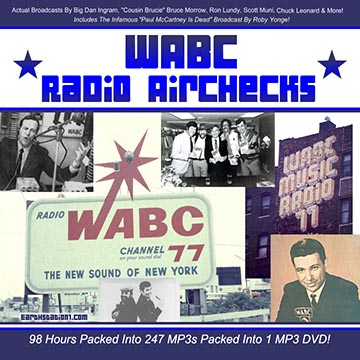
September 13, 1944: #BOTD: #HBD! Peter
Cetera, American singer-songwriter, bass player, and record
producer, best known for being an original member of the rock band
Chicago (1967-1985), before launching a successful solo career, is
#born Peter Paul Cetera in the Morgan Park neighborhood of the far
South Side of Chicago, Illinois, where he was raised. His career
as a recording artist encompasses seventeen albums with Chicago
and eight solo albums. With "If You Leave Me Now", a
song written and sung by Cetera on the group's tenth album,
Chicago garnered its first Grammy Award. It was also the group's
first number one single. The song "Color My World"
became a standard slow dance song played at junior and senior high
school proms throughout America in the 1970s.
https://store.earthstation1.com/wabc-musicradio-shows-mp3-dvd-60s80s-am-360807775.html
Today's
EarthStation1.com 15% (Or More!) Off Commemorative Memorial Title:
The Golden Age Of Rock 'N' Roll DVD, MP4 Video Download, Flash
Drive
Today, September 13, 2026
September 13, 1941: #BOTD: #HBD! David
Clayton-Thomas, British-Canadian musician, singer and songwriter,
best known as the lead vocalist of the American band Blood, Sweat
& Tears (commonly abbreviated as "BS & T") (d.
June 24, 2026) is #born David Henry Thomsett in Kingston upon
Thames, Surrey, England, the son of Fred Thomsett, a decorated
Canadian soldier of World War II. His mother, Freda May (nee
Smith), played the piano and met Thomsett when she came to
entertain the troops at a London hospital. After the war, the
family settled in Willowdale, Toronto, Canada. Clayton-Thomas
inherited a love for music from his mother. His father was an
abusive alcoholic who beat him. By the time he was fourteen, he
had left home and was sleeping in parked cars and abandoned
buildings and stealing food and clothing to survive. He was
arrested several times for vagrancy, petty theft, and street
brawls and spent much of his teens in various jails and
reformatories, including the Burwash Industrial Farm. When an old
guitar came into his possession, left behind by an outgoing
reformatory inmate, David began to teach himself to play. Upon his
release from detention in 1962, he gravitated to the Yonge Street
"strip" in Toronto. Rhythm & blues from Detroit and
Chicago was the main attraction on the strip. Arkansas rockabilly
musician Ronnie Hawkins was then a Toronto resident and recognized
the talent of the young singer, whom he called 'Sonny'. Soon the
singer was fronting his own bands. The first was David Clayton
Thomas and The Fabulous Shays. By this time, he had changed his
surname to put some distance between his new life and his troubled
teenage years. In 1964 Clayton-Thomas and The Shays recorded John
Lee Hooker's "Boom Boom". This led to a New York
appearance on NBC-TV's Hullabaloo at the invitation of host,
fellow Canadian Paul Anka. Abandoning the bars on the strip,
Clayton-Thomas began performing in Yorkville Village's
coffeehouses. He immersed himself in the scene dominated by
Hooker, Joe Williams, Sonny Terry, Brownie McGhee, Lenny Breau,
Oscar Peterson, and Moe Koffman. The album David Clayton Thomas
and the Shays a Go-Go was recorded for Roman Records and released
in Canada in 1965, and was followed by David Clayton Thomas Sings
Like It Is! in 1966. Clayton-Thomas made his mark more forcibly
with his next band, The Bossmen, which included jazz musicians. In
1966 he wrote and sang the R & B-driven anti-war song
"Brainwashed", which became a major Canadian hit,
peaking at No. 11 on the RPM chart. One night in 1966, after
"sitting in" with Hooker in Yorkville, Clayton-Thomas
left with him for New York. They played a Greenwich Village club
for a couple of weeks; Hooker then left for Europe and
Clayton-Thomas stayed on in New York City. He survived by playing
"basket houses", where performers were given a few
minutes to perform and then passed the basket for money. While
back in Toronto in early 1968 he led The David Clayton-Thomas
Combine and released the single "Father Dear Father" on
Yorkville Records just prior to moving back to New York City to
join Blood, Sweat & Tears. In 1968 folk singer Judy Collins
heard Clayton-Thomas at a club in uptown Manhattan and told her
friend, drummer Bobby Colomby. Bobby was looking for a new singer,
as his band, BS & T, had three members leave the group just
four months after releasing the debut Columbia Records album,
Child Is Father to the Man. Colomby was impressed and invited
Clayton-Thomas to join. Clayton-Thomas was one of four members
added, bringing the membership up to nine. The reformed group
debuted the Cafe Au Go-Go in Greenwich Village. Clayton-Thomas's
first album with the band, Blood, Sweat & Tears, was released
in December 1968 and sold ten million copies. It topped the
Billboard Magazine Top Albums chart for seven weeks and charted
for 109 weeks. It won five Grammy Awards. Three hit singles were
included, "You've Made Me So Very Happy", "Spinning
Wheel", and "And When I Die". Each of these peaked
at number 2 on the Billboard Hot 100. Also notable was a new
arrangement of Billie Holiday's "God Bless The Child".
Seeking to capitalize on the singer, Decca Records purchased tapes
of the Roman Records material in 1969. Decca's producer added
horns to make it sound more like Blood, Sweat & Tears, and
released the album David Clayton-Thomas!. BS & T headlined
major venues including; Royal Albert Hall, the Metropolitan Opera
House, the Hollywood Bowl, Madison Square Garden, and Caesars
Palace, as well as the Newport Jazz Festival and Woodstock. From
June to July 1970, the band went on a United States Department of
State-sponsored tour of Eastern Europe. Association with the
United States government was highly unpopular with American rock
fans who opposed the United States war in Vietnam and the band was
criticized for allowing itself to be co-opted by United States
President Richard Nixon's government. Details were later revealed
that the U.S. State Department had pressured the group into the
tour in exchange for a residency permit for Clayton-Thomas, who
had a criminal record in Canada, and had been deported from the
United States after overstaying his travel visa. The tour and its
aftermath is the focus of a 2023 feature-length documentary titled
What the Hell Happened to Blood, Sweat & Tears? The album
Blood, Sweat & Tears 3 was released in June 1970 and featured
Carole King's "Hi-De-Ho" and Clayton-Thomas' "Lucretia
MacEvil". B, S & T; 4 in June 1971 yielded another
Clayton-Thomas-penned hit single, "Go Down Gamblin'",
where he also played electric guitar. Clayton-Thomas also co-wrote
the song "Lisa Listen to Me" with Dick Halligan for this
album. Blood Sweat & Tears' Greatest Hits was released in
February 1972 and has since reached sales of seven million copies.
In BS & T Clayton-Thomas sometimes played additional drums and
percussion with Colomby during instrumental parts, as in the
performance at Stockholm in September 1971. The group traveled all
over Europe, Australia, Asia, South America, the United States,
and Canada. Constant touring began to take its toll.
Clayton-Thomas left BS & T in 1972, exhausted. Variety later
described Clayton-Thomas's decision as ruining the band who
"needed every bit of his sweat and swagger." By the
mid-1970s, the founding members of the band began to drift away to
pursue other goals. In 1972 Clayton-Thomas released his first
Columbia solo album, simply titled David Clayton Thomas. In 1973
his next album Tequila Sunrise was released. He briefly hosted his
own musical and variety TV show The David Clayton-Thomas Show for
CBC Television. The show lasted for three episodes, broadcast in
June and July 1973. In 1974 he issued Harmony Junction on RCA
Records. In 1975 Thomas returned to front BS & T on the albums
New City and, in 1976, More Than Ever. In 1977 they released Brand
New Day on the ABC label. In 1978 Thomas issued another solo album
on ABC, titled Clayton. In 1980 BS & T issued the MCA Records
album Nuclear Blues, which also included the singer. Later in the
decade Columbia issued the double live Blood, Sweat & Tears
album Live and Improvised again with Clayton- Thomas. His 1999
solo album Bloodlines included former band members from BS &
T. It was reported in the May 30, 1992 issue of Cash Box that
Clayton-Thomas was one of the artists on the Sedona Recording
Company roster. In 2004 Clayton-Thomas left New York for Toronto
and launched an All-Star 10-piece band. He then began touring and
recording almost a dozen new albums under his own name.
Clayton-Thomas died at St. Michael's Hospital in Toronto at the
age of 84. Eric Alper, David's spokesman, confirmed the death at a
hospital but did not specify the cause. The singer's two
daughters, Christine Graham and Ashleigh Clayton-Thomas, survived
him. His burial details are not publicly disclosed. David married
four times. Nancy Hewitt was his first wife, followed by Terry
Nusyna, his second wife. Later, he tied the knot with Jennifer
Goodson and, lastly, Suzanne Warren. While Christine was born with
his first wife, Ashleigh was born from third partner,
Jennifer.David and Suzzane married and resided in NYC and the
Catskill Mountains. Their relationship ended in divorce, as had
his prior marriages. The couple did not have kids.The dates of
their marriage ceremony and ultimate divorce judgment were never
made public since David kept his personal life very private.
https://store.earthstation1.com/the-golden-age-of-rock-39n39-roll-dvd-complete-tv-series-5-39395.html
Today's
EarthStation1.com 15% (Or More!) Off Commemorative Memorial Title:
America Goes Over - The Yanks Are Coming! WWI DVD, Download, USB
Drive
Today, September 13, 2026
September 13, 1860: #BOTD: #HBD! John J.
"Black Jack" Pershing, U.S. General of the Armies and
lawyer (d. July 15, 1948) was #born in Laclede, Missouri. His most
famous post was when he served as the commander of the American
Expeditionary Force (AEF) on the Western Front in the last two
years of World War I, and oversaw the Meuse-Argonne Offensive that
helped bring about the Armistice of November 11, 1918. He also
served in combat in the Apache Wars and Sioux Wars, a part of the
Indian Wars; in the Spanish-American War, fighting at the Battle
of San Juan Hill; as commandier of operations to suppress the Moro
Rebellion of the Philippine-American War; as an observer during
the Russo-Japanese War attached to General Kuroki Tamemoto's
Japanese First Army in Manchuria; and as commander of the Pancho
Villa Expedition during the Mexican Revolution. He was also an
expert marksman. and in 1891 was rated second in pistol and fifth
in rifle out of all soldiers in the U.S. Army. In 1897, Pershing
was appointed to the West Point tactical staff as an instructor,
where he was assigned to Cadet Company A. Because of his
strictness and rigidity, Pershing was unpopular with the cadets,
who took to calling him "Nigger Jack" because of his
service with the 10th Cavalry Regiment, a now famous unit formed
as a segregated African American unit and one of the original
"Buffalo Soldier" regiments. During the course of his
tour at the Academy, this epithet softened to "Black Jack,"
although it was intended to be an insult. This nickname would
stick with him for the rest of his life, and was known to the
public as early as 1917. On the morning of August 27, 1915, he
received a telegram informing him of a fire in the Presidio in San
Francisco, where a lacquered floor caught fire and the flames
rapidly spread, resulting in the smoke inhalation deaths of his
wife, Helen Frances Warren, and three young daughters, Mary, age
3, Anne, age 7, and Helen, age 8. Only his 6-year-old son Francis
Warren survived. Two years after the death of his wife and
children, Pershing courted Anne Wilson "Nita" Patton,
the younger sister of his protege, George S. Patton. Pershing met
her when she traveled to Fort Bliss, where Pershing was commanding
officer, to visit her brother, and he introduced them. Pershing
and Nita Patton soon began a relationship; they became engaged in
1917, but their separation because of Pershing's time in France
during World War I ended it.Pershing had wartime affairs,
including one with an artist who painted his portrait, and he
later expressed regret that he had let Nita Patton "get
away". She never married, and Pershing never remarried.
During World War I, Pershing rejected British and French demands
that American forces be integrated with their armies, and insisted
that the AEF would operate as a single unit under his command,
although some American divisions fought under British command, and
he also allowed all-black units to be integrated with the French
army. Pershing's soldiers first saw serious battle at Cantigny,
Chateau-Thierry, Belleau Wood, and Soissons. To speed up the
arrival of the doughboys, they embarked for France leaving the
heavy equipment behind, and used British and French tanks,
artillery, airplanes and other munitions. In September 1918 at St.
Mihiel, the First Army was directly under Pershing's command; it
overwhelmed the salient - the encroachment into Allied territory -
that the German Army had held for three years. For the
Meuse-Argonne Offensive, Pershing shifted roughly 600,000 American
soldiers to the heavily defended forests of the Argonne, keeping
his divisions engaged in hard fighting for 47 days, alongside the
French. The Allied Hundred Days Offensive, which the Argonne
fighting was part of, contributed to Germany calling for an
armistice. Pershing was of the opinion that the war should
continue and that all of Germany should be occupied in an effort
to permanently destroy German militarism. Pershing is the only
American to be promoted in his own lifetime to General of the
Armies rank, the highest possible rank in the United States Army.
Allowed to select his own insignia, Pershing chose to use four
gold stars to distinguish himself from those officers who held the
rank of General, which was signified with four silver stars. After
the creation of the five-star General of the Army rank during
World War II, his rank of General of the Armies could unofficially
be considered that of a six-star general, but he died before the
proposed insignia could be considered and acted on by Congress.
Pershing died of coronary artery disease and congestive heart
failure at age 87 at Walter Reed General Hospital in Washington,
D.C., which was his home after 1944. He lay in state at the United
States Capitol rotunda, and following a state funeral, he was
buried in Arlington National Cemetery near the grave sites of the
soldiers he commanded in Europe. The site is now known as Pershing
Hill. George C. Marshall, then serving as U.S. Secretary of State,
was in charge of funeral plans. Some of his tactics have been
criticized both by other commanders at the time and by modern
historians. His reliance on costly frontal assaults, long after
other Allied armies had abandoned such tactics, has been blamed
for causing unnecessarily high American casualties. In addition to
leading the A.E.F. to victory in World War I, Pershing notably
served as a mentor to many in the generation of generals who led
the United States Army during World War II, including George
Marshall, Dwight D. Eisenhower, Omar Bradley, Lesley J. McNair,
George S. Patton, and Douglas MacArthur.
https://store.earthstation1.com/america-goes-over--the-yanks-are-coming-wwi-propaganda-dvd.html
Today's
EarthStation1.com 15% (Or More!) Off Commemorative Memorial Title:
Stonewall Jackson Bios: American Civil War & Mexican War DVD
MP4 USB
Today, September 13, 2026
September 13, 1847: The Mexican-American
War (The Mexican War): The Battle For Mexico City: The Battle Of
Chapultepec: Los Ninos Heroes (Spanish: The Boy Heroes): -- #DOTD:
#RIP: Six Mexican teenage military cadets die defending
Chapultepec Castle from invading American forces under General
Winfield Scott during The Battle Of Chapultepec, a part of the
Battle For Mexico City. According to legend, in an act of bravery,
Juan Escutia wrapped the Mexican flag around his body and jumped
from the top of the castle in order to keep it from falling into
the enemy's hands. The Ninos Heroes are a key part of Mexico's
patriotic folklore, commemorated by a national holiday on
September 13, Dia de los Ninos Heroes (Day of the Boy Heroes).
However, several modern Mexican historians claim that parts of the
story are not factual. Chapultepec Castle (Spanish: Castillo de
Chapultepec) is located on top of Chapultepec Hill. The name
Chapultepec stems from the Nahuatl word chapoltepec which means
"at the grasshopper's hill". The castle has such
unparalleled views and terraces that historian James F. Elton
wrote that they can't "be surpassed in beauty in any part of
he world". It is located in the middle of Chapultepec Park in
Mexico City at a height of 2,325 meters (7,628 ft) above sea
level. The site of the hill was a sacred place for Aztecs, and the
buildings atop it have served several purposes during its history,
including that of Military Academy, Imperial residence,
Presidential home, observatory, and presently, the National Museum
of History. It is the only royal castle in the Americas. American
troops under General Winfield Scott went on after their victory at
Chapultepec to win the Battle For Mexico City. When the Duke of
Wellington, victor of Waterloo, learned that Scott had succeeded
against alarming odds in capturing Mexico City, he proclaimed
Scott "the greatest living general".
https://store.earthstation1.com/stonewall-jackson-bios-american-civil-war-amp-mexican-war-dvd-mp4-us4.html
Today's
EarthStation1.com 15% (Or More!) Off Commemorative Memorial Title:
The Machine That Changed The World: The Computer DVD MP4 Download
Today, September 13, 2026
September 13, 1956: Premieres: The
Industrial Revolution: The Third Industrial Revolution
(1947-Present) (The Information Age, The Computer Age, The Digital
Age, The Digital Electronics Revolution, The Silicon Age, The New
Media Age, The Media Age): The Computer: The History Of The
Computer: Digital Computers: The History Of Computing Hardware:
The History Of The Computer Industry: The History Of Commercial
Computers: The IBM 305 RAMAC: -- The IBM 305 RAMAC, the first
commercial computer to use disk storage, is introduced. The IBM
305 RAMAC (Random Access Method of Accounting and Control) used a
moving-head hard disk drive to store information, as distinguished
from magnetic tape storage, for secondary data storage. The system
was publicly announced on September 14, 1956, with test units
already installed at the U.S. Navy and at private corporations.
RAMAC's design was motivated by the need for immediate, real-time
accounting in business and government. RAMAC was developed and
manufactured at IBM's research facility in San Jose, California.
In 1959, IBM's CEO Thomas J. Watson Jr. exhibited the RAMAC in
Moscow. This led to a visit by Soviet leader Nikita Khrushchev to
IBM's San Jose facility. The first RAMAC to be used in the U.S.
auto industry was installed at Chrysler's MOPAR Division in 1957.
It replaced a huge tub file which was part of MOPAR's parts
inventory control and order processing system. During the 1960
Olympic Winter Games in Squaw Valley (USA), IBM provided the first
electronic data processing systems for the Games. The system
featured an IBM RAMAC 305 computer, punched card data collection,
and a central printing facility. More than 1,000 systems were
built. Production ended in 1961; the RAMAC computer became
obsolete in 1962 when the IBM 1405 Disk Storage Unit for the IBM
1401 was introduced, and the 305 was withdrawn in 1969.
https://store.earthstation1.com/the-machine-that-changed-the-world-the-computer-dvd-mp4-downloa4.html
Today's
EarthStation1.com 15% (Or More!) Off Commemorative Memorial Title:
Perspectives On 20th Century Architecture Japan MP4 Video Download
DVD
Today, September 13, 2026
September 13, 1941: #BOTD: #HBD! Tadao
Ando, Japanese autodidact (self-educated) architect whose approach
to architecture and landscape was defined by architectural
historian Francesco Dal Co as "critical regionalism", an
approach to architecture that strives to counter the placelessness
and lack of identity of the International Style, but also rejects
the whimsical individualism and ornamentation of Postmodern
architecture, is #born Ando Tadao a few minutes before his twin
brother in 1941 in Minato-ku, Osaka, Japan. He is the recipient of
the 1995 The Pritzker Architecture Prize, an international award
presented annually "to honor a living architect or architects
whose built work demonstrates a combination of those qualities of
talent, vision and commitment which has produced consistent and
significant contributions to humanity and the built environment
through the art of architecture." Founded in 1979 by Jay A.
Pritzker and his wife Cindy, the award is funded by the Pritzker
family and sponsored by the Hyatt Foundation. It is considered to
be one of the world's premier architecture prizes, and is often
referred to as the Nobel Prize of architecture. At the age of two,
his family chose to separate them and have Tadao live with his
great-grandmother. He worked as a boxer and fighter before
settling on the profession of architect, despite never having
formal training in the field. Struck by the Frank Lloyd
Wright-designed Imperial Hotel on a trip to Tokyo as a second-year
high school student, he eventually decided to end his boxing
career less than two years after graduating from high school to
pursue architecture. He attended night classes to learn drawing
and took correspondence courses on interior design. He visited
buildings designed by renowned architects like Le Corbusier,
Ludwig Mies van der Rohe, Frank Lloyd Wright, and Louis Kahn
before returning to Osaka in 1968 to establish his own design
studio, Tadao Ando Architects and Associates. Ando was raised in
Japan where the religion and style of life strongly influenced his
architecture and design. Ando's architectural style is said to
create a "haiku" effect, emphasizing nothingness and
empty space to represent the beauty of simplicity. He favors
designing complex spatial circulation while maintaining the
appearance of simplicity. A self-taught architect, he keeps his
Japanese culture and language in mind while he travels around
Europe for research. As an architect, he believes that
architecture can change society, that "to change the dwelling
is to change the city and to reform society". "Reform
society" could be a promotion of a place or a change of the
identity of that place. Werner Blaser has said, "Good
buildings by Tadao Ando create memorable identity and therefore
publicity, which in turn attracts the public and promotes market
penetration". The simplicity of his architecture emphasizes
the concept of sensation and physical experiences, mainly
influenced by Japanese culture. The religious term Zen, focuses on
the concept of simplicity and concentrates on inner feeling rather
than outward appearance. Zen influences vividly show in Ando's
work and became its distinguishing mark. In order to practice the
idea of simplicity, Ando's architecture is mostly constructed with
concrete, providing a sense of cleanliness and weightlessness
(even though concrete is a heavy material) at the same time. Due
to the simplicity of the exterior, construction, and organization
of the space are relatively potential in order to represent the
aesthetic of sensation. Besides Japanese religious architecture,
Ando has also designed Christian churches, such as the Church of
the Light (1989) and the Church in Tarumi (1993). Although
Japanese and Christian churches display distinct characteristics,
Ando treats them in a similar way. He believes there should be no
difference in designing religious architecture and houses. As he
explains, "We do not need to differentiate one from the
other. Dwelling in a house is not only a functional issue, but
also a spiritual one. The house is the locus of heart (kokoro),
and the heart is the locus of god. Dwelling in a house is a search
for the heart (kokoro) as the locus of god, just as one goes to
church to search for god. An important role of the church is to
enhance this sense of the spiritual. In a spiritual place, people
find peace in their heart (kokoro), as in their homeland."
Besides speaking of the spirit of architecture, Ando also
emphasises the association between nature and architecture. He
intends for people to easily experience the spirit and beauty of
nature through architecture. He believes architecture is
responsible for performing the attitude of the site and makes it
visible. This not only represents his theory of the role of
architecture in society but also shows why he spends so much time
studying architecture from physical experience. In 1995, Ando won
the Pritzker Prize for architecture, considered the highest
distinction in the field. He donated the 100K USD prize money to
the orphans of the 1995 Kobe earthquake. Tadao Ando's body of work
is known for the creative use of natural light and for structures
that follow natural forms of the landscape, rather than disturbing
the landscape by making it conform to the constructed space of a
building. Ando's buildings are often characterized by complex
three-dimensional circulation paths. These paths weave in between
interior and exterior spaces formed both inside large-scale
geometric shapes and in the spaces between them. His "Row
House in Sumiyoshi" (Azuma House), a small two-story,
cast-in-place concrete house completed in 1976, is an early work
which began to show elements of his characteristic style. It
consists of three equal rectangular volumes: two enclosed volumes
of interior spaces separated by an open courtyard. The courtyard's
position between the two interior volumes becomes an integral part
of the house's circulation system. The house is famous for the
contrast between appearance and spatial organization which allow
people to experience the richness of the space within the
geometry. Ando's housing complex at Rokko, just outside Kobe, is a
complex warren of terraces and balconies, atriums and shafts. The
designs for Rokko Housing One (1983) and for Rokko Housing Two
(1993) illustrate a range of issues in traditional architectural
vocabulary-the interplay of solid and void, the alternatives of
open and closed, the contrasts of light and darkness. More
significantly, Ando's noteworthy engineering achievement in these
clustered buildings is site specific-the structures survived
undamaged after the Great Hanshin earthquake of 1995. New York
Times architectural critic Paul Goldberger argues that "Ando
is right in the Japanese tradition: spareness has always been a
part of Japanese architecture, at least since the 16th century; it
is not without reason that Frank Lloyd Wright more freely admitted
to the influences of Japanese architecture than of anything
American." Unlike the architect Auguste Perret, who pioneered
the use of reinforced concrete, Ando used shuttering formwork to
give concrete building elements their shape. The finished Ando
building bears the memory of wood texture. The smoothness of the
concrete is achieved by the careful preparation of the casting
moulds. Ando buildings are credited with the interior design use
of exposed concrete. The use of prominent beams is perceived to be
rooted in Japanese architectural history. The Rokko apartments and
the Church of the Light earned Ando international recognition and
he was noted by those who detect a regional quality in concrete
construction. In 2003, Ando was commissioned by soap opera heir
William Bell, Jr. and his wife Maria to design a house for an
almost 6-acre (2.4 ha) oceanfront site on the East Pacific Coast
Highway in the Paradise Cove area of Malibu, California. The house
(designed with WHY Architects) is a 40,000-square-foot (3,700 m2)
modernist concrete structure in an L shape, with six bedrooms and
walls of glass. It has been described as minimalist and "echoey".
Construction completed in 2014, being prolonged due to the
oceanfront location, soft soil, and California's extensive
building codes. 7,645 cubic yards of unusually high quality
concrete were used in the construction of the house, with its
rebar specially treated to resist corrosion. The installation of
the concrete in the driveway, garage, and parking areas in 2015
won an award for precision from the American Concrete Institute.
Ando also designed a series of furniture pieces for the interior.
In May 2023, couple Beyonce and Jay-Z purchased the house through
a trust for 200M USD. It was the most expensive single-family home
sold in the United States in 2023. and surpassed California's
previous record price for a residence, set by businessman Marc
Andreessen in 2021 for the adjacent house.
https://store.earthstation1.com/perspectives-on-20th-century-architecture-japan-d20.html
Today's
EarthStation1.com 15% (Or More!) Off Commemorative Memorial Title:
United Nations Documentaries Set DVD MP4 Download USB Drive
Today, September 13, 2026
September 13, 2007: Human Rights: The
Human Rights Movement: Indigenous Rights: The Indigenous Rights
Movement: The United Nations: United Nations General Assembly
Resolutions: The Declaration On The Rights Of Indigenous Peoples
(UNDRIP, DOTROIP) (UN General Assembly Resolution 61/295
[UNGAR61/295[): -- The United Nations General Assembly, by a vote
on a Thursday of 143 in favor, 4 against, 11 abstentions and 34
absent, formally adopts The Declaration On The Rights Of
Indigenous Peoples, a legally non-binding resolution that
delineates and defines the individual and collective rights of
Indigenous peoples, including their ownership rights to cultural
and ceremonial expression, identity, language, employment, health,
education, and other issues. Their ownership also extends to the
protection of their intellectual and cultural property. The
Declaration "emphasizes the rights of Indigenous peoples to
maintain and strengthen their own institutions, cultures and
traditions, and to pursue their development in keeping with their
own needs and aspirations." It "prohibits discrimination
against indigenous peoples," and it "promotes their full
and effective participation in all matters that concern them and
their right to remain distinct and to pursue their own visions of
economic and social development". The goal of the declaration
is to encourage countries to work alongside indigenous peoples to
solve global issues, such as development, multicultural democracy,
and decentralization. Since 2007, the four countries voting
against have reversed their position and now support the
Declaration. As of February 2020, the United Nations Department of
Economic and Social Affairs, Indigenous Peoples describe
(A/RES/61/295) as "...the most comprehensive international
instrument on the rights of indigenous peoples. It establishes a
universal framework of minimum standards for the survival, dignity
and well-being of the indigenous peoples of the world and it
elaborates on existing human rights standards and fundamental
freedoms as they apply to the specific situation of indigenous
peoples." As a General Assembly Declaration, UNDRIP is not a
legally binding instrument under international law. According to a
UN press release it does "represent the dynamic development
of international legal norms and it reflects the commitment of the
UN's member states to move in certain directions"; the UN
describes it as setting "an important standard for the
treatment of indigenous peoples that will undoubtedly be a
significant tool toward eliminating human rights violations
against the planet's 370 million indigenous people, and assisting
them in combating discrimination and marginalisation." UNDRIP
codifies "Indigenous historical grievances, contemporary
challenges and socio-economic, political and cultural aspirations"
and is the "culmination of generations-long efforts by
Indigenous organizations to get international attention, to secure
recognition for their aspirations, and to generate support for
their political agendas." Canada Research Chair and faculty
member at the University of Saskatchewan Ken Coates argues that
UNDRIP resonates powerfully with Indigenous peoples, while
national governments have not yet fully understood its impact.
https://store.earthstation1.com/united-nations-documentaries-set-dvd-mp4-download-usb-driv4.html
Today's
EarthStation1.com 15% (Or More!) Off Commemorative Memorial Title:
Black Civil Rights Films: African-American History DVD, MP4, USB
Stick
Today, September 13, 2026
September 13, 1948: Civil Rights
Movements: The American Civil Rights Movement: The American Civil
Rights Movement (1896-1954) (The Jim Crow Era): Elections:
Elections In The United States: The 1948 United States
Presidential Election: Henry A. Wallace's 1948 Presidential
Campaign Radio Address On Southern Discrimination And Segregation:
-- Former Vice President Henry A. Wallace, Jr., the 1948
Presidential nominee of the Progressive Party, gives a radio
address to the American people at NBC in which he describes in
detail his calls for the end of both discrimination and
segregation in the South and the rest of the nation. Wallace ran a
spirited campaign which unlike almost any before, took on the
question of racial discrimination and segregation against African
Americans in the South. It began: "I have been in the South
so many times and every time I have found many new things. But
never were my eyes opened so widely as on my last trip. It is a
strange experience to stand on the main street of an American town
and to ask only for the right to speak = and to be denied that
right. It is a strange experience to look into faces blinded by
unreasoning hate, to see people who will not let you speak, when
the words concern the improvement of the lives of the very people
before you. Yes I have seen the South many times: the thousands of
unpainted shacks, the families living in houses with no doors in
the door frames and no windows in the window frames; where a man
and his family sleep in one room, all of them sleeping in one bed
in cold weather, the children sleeping on the floor in warm
weather. The people of the South are fine people: our aspirations
are their aspirations. They are a patriotic people, a religious
people. And it is this that struck me on my recent trip: that the
basic human need of the South is simply a reconciling of our daily
action with what we are taught in the church and what we are
taught in school. The foundation of patriotism and religion is the
doctrine of the Fatherhood of God and the Brotherhood of Man. The
Brotherhood of Man sets forth no limitation of color. The
Constitution of the United States sets forth very specifically
that the rights of citizens to vote shall not be denied on account
of race or color. I came out of the South utterly convinced that
these denials of God and man are evils which can cost this nation
its very life.". That same day, Time Magazine, who typically
dated their print articles on days other than when they were
either written, accepted or published, chose this same September
13, 1948 date as the publication of is article on the event,
entitled "Eggs in the Dust": "In his assault on the
South last week, Henry Wallace acted more like an agitator than a
presidential candidate. He ostentatiously rode through cities and
towns with his Negro secretary in the seat beside him. He chose
the homes of Negro supporters for meals and overnight stops. In
Little Rock, his supporters picked four places for him to speak,
knowing that he might be refused permission at all four (he was),
knowing also that there were at least a dozen places where he
could have spoken without raising any objection. Jeering Crowds.
Wallace was sincerely and visibly shaken by his hostile reception.
Said Wallace: "There is something so unlovely about hate when
you see it distorting the human face." In three days in North
Carolina, booing, jeering crowds drowned out his attempts to
speak. He and his party were pelted with dozens of eggs and
tomatoes. He was hit at least nine times, splattered by near
misses five times. In Hickory, N.C., two rotten eggs plopped near
him. Cried Wallace bitterly: "As Jesus Christ told his
disciples, if at any town they will not listen to you will ingly,
then shake the dust from your feet and go elsewhere."* He
shook off the dust of Hickory.After that, Henry was not without
sympathizers. North Carolina's Governor Gregg Cherry condemned the
mob's conduct. President Truman denounced it as "highly
un-American." Mississippi's Governor Fielding Wright, the
Dixiecrats' vice presidential candidate, urged all Mississippians
to behave. In Greensboro, N.C., Judge E. Earle Rives sentenced two
teenage egg-throwers to write over & over: "I disapprove
of what you say but I will defend to the death your right to say
it." The nation's press, including the South's, lectured on
the right of free speech. In Birmingham, Ala., Public Safety
Commissioner Eugene ("Bull") Connor was on record: "I
ain't gonna let no darkies and white folk segregate together in
this town." While Wallace waited in his car near by, a
representative announced that he would not speak to any meeting
that "violates the right of free assembly"-meaning a
segregated meeting. A volley of eggs sailed over his head. A
small, angry group found Wallace's car, thumped fists on its
fenders, took turns glaring through the windows. "Look at
that guy," said one. "He can't even afford to get a
haircut." Cried Wallace: "There is a long chain that
links unknown young hoodlums in North Carolina or Alabama with men
in finely tailored business suits in the great financial centers
of New York or Boston, men who make a dollars & cents profit
by setting race against race in the far away South." Wallace
added: "If the U.S. does not get right on the segregation
problem, she will lose her position of leadership in world
affairs." Ventured Witticism. The rest of the Wallace tour
continued through an atmosphere of smoldering but restrained
hostility. There were lapses. In Monroe, La., a tomato sploshed on
his car. In Shreveport, he ran into a barrage of eggs and
tomatoes. One egg struck his car in Memphis. But at his last
speeches in Tennessee, in the heart of TVA territory, he was
cheered. Wallace plucked up his spirits, ventured a witticism. He
declared that he was trying to develop an egg of higher viscosity.
"It won't scatter so far when it breaks-a sort of
non-spattering egg." What had he achieved? He had thrown a
harsh light on the problem of racial segregation-a problem which
the U.S. as a whole cannot continue to shrug off. He had shown
that there are a few hooligans in the South and also responsible
statesmen who deplore hooliganism. He had found material for
future demagogic campaign speeches, although it was unlikely that
he had changed many votes. Wrote the Charlotte, N.C. News: ".
. . he mortifies us. There are men in the world who are bothered
with neither Henry Wallace's confusion nor his extensive good
will. They are trading on him, and he, the poor sap, is peddling
his wares of doubt, uncertainty, and confusion, scourging himself
and singing psalms." In Rexburg, Idaho, two ex-G.I.s tossed
peaches and eggs at Senator Glen Taylor, Henry Wallace's running
mate. In West Frankfort, a southern Illinois mining town, a gang
of young toughs broke up a meeting and stoned Curtis MacDougall,
Progressive candidate for U.S. Senator. MacDougall was hit by ten
stones as he retreated to his trailer with his wife and children.
At week's end, Tass's New York Bureau gleefully cabled Moscow that
an organized reign of terror conducted by "fascist hooligans"
was under way against Wallace and his Progressives.
https://store.earthstation1.com/black-civil-rights-films-africanamerican-history-dvd.html
Today's
EarthStation1.com 15% (Or More!) Off Commemorative Memorial Title:
The FBI's War On Black America: COINTELPRO MP4 Video Download DVD
Today, September 13, 2026
September 13, 1947: #BOTD: #HBD! Geronimo
Pratt, also known as Geronimo Ji-Jaga and Geronimo Ji-Jaga Pratt,
African American war hero, highly decorated military veteran and a
high-ranking member of the Black Panther Party in the United
States in the late 1960s and early 1970s (d. June 2, 2011) is
#born Elmer Pratt in Morgan City, Louisiana, where his father was
in the scrap metal business. Pratt was raised Catholic. Pratt was
a star quarterback at Sumpter Williams High School. He served two
tours in Vietnam, earning two Bronze Stars, a Silver Star, and two
Purple Hearts. He moved to Los Angeles, where he studied at UCLA
under the GI Bill, and joined the Black Panther Party after seeing
police actions against African American community members that
made him flash back to similar military actions he undertook
during the Vietnam War. The Federal Bureau of Investigation
targeted Pratt in a COINTELPRO operation in the early 1970s,
intended to "neutralize Pratt as an effective BPP
functionary." Pratt was knowingly prosecuted for a crime the
FBI knew he did not commit: the 1968 murder of Caroline Olsen. He
was tried and convicted in 1972, and served 27 years in prison,
eight of which were in solitary confinement. Pratt was freed in
1997 when his conviction was vacated due to the prosecution's
having withheld exculpatory evidence that tended to prove his
innocence. This decision was upheld on appeal. He worked as a
human rights activist until the time of his death. Pratt was also
the godfather of the late rapper Tupac Shakur. He died of a heart
attack in Arusha, Tanzania, aged 63. His burial details have not
been publicly disclosed.
https://store.earthstation1.com/the-fbis-war-on-black-america-cointelpro-mp4-video-download-dvd.html
Today's
EarthStation1.com 15% (Or More!) Off Commemorative Memorial Title:
Pioneers Of Surgery Documentary TV Series DVD, MP4 Download, USB
Drive
Today, September 13, 2026
September 13, 1848: Medicine: The History
Of Medicine: Surgery: The History Of Surgery: Neurosurgery: The
History Of Neurosurgery: Neurology: The History Of Neurology:
Neuroscience: The History Of Neuroscience: The American Crowbar
Case (The Phineas Gage Case): -- Vermont railroad construction
foreman Phineas Gage survives an iron rod 1 1/4 inches (3.2 cm) in
diameter being driven completely through his head, destroying much
of his brain's left frontal lobe; the reported effects on his
behavior and personality over the remaining 12 years of his life,
effects sufficiently profound that friends saw him as "no
longer Gage", stimulate thinking about the nature of the
brain and its functions. Surgeon H. F. Campbell wrote in the Ohio
Medical & Surgical Journal his 1851 article "Injuries of
the Cranium - Trepanning" that this was "the case which
more than all others is calculated to excite our wonder, impair
the value of prognosis, and even to subvert our physiological
doctrines". Long known as the "American Crowbar Case",
Phineas P. Gage (July 9, 1823 - May 21, 1860) influenced
19th-century discussion about the mind and brain, particularly
debate on cerebral localization, and was perhaps the first case to
suggest the brain's role in determining personality, and that
damage to specific parts of the brain might induce specific mental
changes. Gage is a fixture in the curricula of neurology,
psychology, and neuroscience, one of the great medical curiosities
of all time and a part of medical folklore, frequently mentioned
in books and scientific papers. Despite this celebrity, the body
of established fact about Gage and what he was like (whether
before or after his injury) is small, with Gage acting as a
"Rorschach inkblot" in which proponents of various
conflicting theories of the brain all saw support for their views.
Historically, published accounts of Gage (including scientific
ones) have almost always severely exaggerated and distorted his
behavioral changes, frequently contradicting the known facts. A
report of Gage's physical and mental condition shortly before his
death implies that his most serious mental changes were temporary,
so that in later life he was far more functional, and socially far
better adapted, than in the years immediately following his
accident. A social recovery hypothesis suggests that his work as a
stagecoach driver in Chile fostered this recovery by providing
daily structure which allowed him to regain lost social and
personal skills. According to John Martyn Harlow's 1868 "Recovery
from the Passage of an Iron Bar through the Head", On May 18,
1860, Gage "left Santa Clara and went home to his mother. At
5 o'clock, A.M., on the 20th, he had a severe convulsion. The
family physician was called in, and bled him. The convulsions were
repeated frequently during the succeeding day and night," and
he died in status epilepticus, a single seizure lasting more than
five minutes or two or more seizures within a five-minute period
without the person returning to normal between them, in or near
San Francisco, late on May 21, 1860. He was buried in San
Francisco's Lone Mountain Cemetery.
https://store.earthstation1.com/pioneers-of-surgery-dvd-set-4-episode-tv-series-2-dis42.html
Today's
EarthStation1.com 15% (Or More!) Off Commemorative Memorial Title:
The American Diary: US History 1895-1933 TV Series DVD MP4 USB
Drive
Today, September 13, 2026
September 13, 1851: #BOTD: Walter Reed,
American biologist, epidemiologist, bacteriologist and U.S. Army
physician who in 1901 led the team that confirmed the theory of
the Cuban doctor Carlos Finlay that yellow fever is transmitted by
a particular mosquito species, rather than by direct contact (d.
November 22, 1902) is #born in Belroi, Virginia, to Lemuel Sutton
Reed (a traveling Methodist minister) and his first wife, Pharaba
White. U.S. Army Major Walter Reed, M.D. gave impetus to the new
fields of epidemiology and biomedicine, and most immediately
allowed the resumption and completion of work on the Panama Canal
(1904-1914) by the United States. Reed followed work started by
Carlos Finlay and directed by George Miller Sternberg who has been
called the "first U.S. bacteriologist". Walter Reed died
in Washington, D.C., of peritonitis caused by a ruptured appendix
at age 51. He is buried in Arlington National Cemetery. In 1912,
he posthumously received what came to be known as the Walter Reed
Medal in recognition of his work to combat yellow fever. A
tropical medicine course is also named after him, Walter Reed
Tropical Medicine Course. In 1940, the U.S. Post Office issued a
stamp bearing his likeness in his honor. In addition to the medal,
course and stamp, many locations and institutions are named after
him, most famously Walter Reed General Hospital (WRGH) in
Washington, D.C..
https://store.earthstation1.com/american-diary-complete-us-historytv-series-2-dual-layer-dvd2.html
Today's
EarthStation1.com 15% (Or More!) Off Commemorative Memorial Title:
The Old Time Radio World War II MP3 MegaSet DVD, Audio Download,
USB
Today, September 13, 2026
September 13, 1894: #BOTD: #HBD! J. B.
Priestley, English novelist, playwright, scriptwriter, social
commentator, and broadcaster (d. August 14, 1984) is #born John
Boynton Priestley at 34 Mannheim Road, Manningham, which he
described as an "extremely respectable" suburb in
Manningham, Bradford, West Riding of Yorkshire, England. J. B.
Priestley OM (Order Of Merit) reflected his Yorkshire background
in much of his fiction, notably in The Good Companions (1929),
which first brought him to wide public notice. Many of his plays
are structured around a time slip, and he went on to develop a new
theory of time, with different dimensions that link past, present,
and future. In 1940, he was a regular broadcaster on the BBC. He
broadcast The Postscript, a series of short propaganda radio talks
on Sunday nights through 1940 and again in 1941, He drew peak
audiences of 16 million; only Churchill was more popular with
listeners. They were credited with strengthening civilian morale
during the Dunkirk Evacuation and the Battle Of Britain. Graham
Greene wrote that Priestley "became in the months after
Dunkirk a leader second only in importance to Mr. Churchill. And
he gave us what our other leaders have always failed to give us -
an ideology." But his talks were cancelled; it was thought
that this was the effect of complaints from Churchill that they
were too left-wing; however, in 2015 Priestley's son said in a
talk on the latest book being published about his father's life
that it was in fact Churchill's Cabinet that brought about the
cancellation by supplying negative reports on the broadcasts to
Churchill. In the following years, his left-wing beliefs continued
to bring him into conflict with the government, but it also helped
to influenced the development of the post-war welfare state. J. B.
Priestley died of pneumonia in Alveston, Warwickshire, England, a
month short of his ninetieth birthday. His ashes were buried in
Hubberholme churchyard at the head of Wharfedale in Yorkshire. The
exact location of his ashes has never been made public and was
known only to the three people present. A plaque in the church
just states that his ashes are buried 'nearby'. Three photographs
exist showing the ashes being interred, taken by Dr Brian Hoyle
Thompson. He and his wife were two of the three people present.
The brass plate on the box containing the ashes reads J. B.
Priestley and can be seen clearly in one of the pictures.
https://store.earthstation1.com/the-old-time-radio-world-war-ii-megaset-2-dual-layer-mp3-dv23.html
Today's
EarthStation1.com 15% (Or More!) Off Commemorative Memorial Title:
The French Revolution Series + Irish Rebellion & You Are There
MP4 DVD
Today, September 13, 2026
September 13, 1791: The Age Of
Enlightenment (The Enlightenment, The Age Of Reason): The Age Of
Revolution: The Atlantic Revolutions: The French Revolution: The
French Constitution Of 1791 (French: Constitution Francaise Du 3
Septembre 1791): -- The basic precepts of the French Revolution --
the adoption of constitutionality (the rule of law in accordance
with a written national constitution) and the establisment of
popular sovereignty (the rule of the people through a government
created and maintained by the people through officials elected by
the people) - is first achieved with the short-lived French
Constitution Of 1791, the first written constitution in the
history of France, created after the collapse of the absolute
monarchy of The Ancien Regime (French" "Old Regime",
the political and social system of the Kingdom of France), is
reluctantly accepted by King Louis XVI after very long
negotiations. Created after the collapse of the absolute monarchy,
The French Constitution Of 1791 redefined the organization of the
French government, citizenship and the limits to the powers of
government, and in so doing, the National Assembly set out to
represent the interests of the general will. It abolished many
"institutions which were injurious to liberty and equality of
rights". The National Assembly asserted its legal presence in
French government by establishing its permanence in the
Constitution and forming a system for recurring elections. The
Assembly's belief in a sovereign nation and in equal
representation can be seen in the constitutional separation of
powers. The National Assembly was the legislative body, the king
and royal ministers made up the executive branch and the judiciary
was independent of the other two branches. On a local level, the
previous feudal geographic divisions were formally abolished, and
the territory of the French state was divided into several
administrative units, Departments (Departements), but with the
principle of centralism.
https://store.earthstation1.com/the-french-revolution-dvd-3-part-tv-documentary-serie3.html
Today's
EarthStation1.com 15% (Or More!) Off Commemorative Memorial Title:
The Story Of Civilization: Will & Ariel Durant DVD, MP3
Download, USB
Today, September 13, 2026
September 13, 509 BC: Rome: Ancient Rome:
Religion In Ancient Rome: Temples: Temples Of Rome: Temples Of
Ancient Rome: Temple Dedications: Temples Of The Capitoline Hill:
The Temple Of Jupiter Optimus Maximus (The Temple Of Jupiter
Capitolinus) (Latin: Aedes Iovis Optimi Maximi Capitolini;
Italian: Tempio Di Giove Ottimo Massimo; " The Temple Of
Jupiter The Best And Greatest'): -- The first Temple of Jupiter
Optimus Maximus on Rome's Capitoline Hill is dedicated on the ides
of September. The Temple of Jupiter Optimus Maximus, also known as
the Temple of Jupiter Capitolinus (Latin: Aedes Iovis Optimi
Maximi Capitolini; Italian: Tempio di Giove Ottimo Massimo;
English: "Temple of Jupiter, the Best and Greatest") was
the most important temple in Ancient Rome, located on the
Capitoline Hill. It was surrounded by the Area Capitolina, a
precinct where numerous shrines, altars, statues and victory
trophies were displayed. The first building was the oldest large
temple in Rome, and, like many temples in central Italy, shared
features with Etruscan architecture. It was traditionally
dedicated in 509 BC, and in 83 BC was destroyed by fire, and a
replacement in Greek style completed in 69 BC (there were to be
two more fires and new buildings). For the first temple sources
report Etruscan specialists being brought in for various aspects
of the building, including making and painting the extensive
terracotta elements of the Temple of Zeus or upper parts, such as
antefixes. But for the second building they were summoned from
Greece, and the building was presumably essentially Greek in
style, though like other Roman temples it retained many elements
of Etruscan form. The two further buildings were evidently of
contemporary Roman style, although of exceptional size. The first
version is the largest Etruscan-style temple recorded, and much
larger than other Roman temples for centuries after. However, its
size remains heavily disputed by specialists; based on an ancient
visitor it has been claimed to have been almost 60 m (200 ft), not
far short of the largest Greek temples. Whatever its size, its
influence on other early Roman temples was significant and
long-lasting. Reconstructions usually show very wide eaves, and a
wide colonnade stretching down the sides, though not round the
back wall as it would have done in a typical Greek temple. A crude
image on a coin of 78 BC shows only four columns, and a very busy
roofline. With two further fires, the third temple only lasted
five years, to 80 AD, but the fourth survived until the fall of
the empire. Remains of the last temple survived to be pillaged for
spolia in the Middle Ages and Renaissance, but now only elements
of the foundations and podium or base survive; as the subsequent
temples apparently reused these, they may partly date to the first
building. Much about the various buildings remains uncertain.
https://store.earthstation1.com/story-of-civilization-will-amp-ariel-durant-mp3-dvd-11-audiobo311.html
Today's
EarthStation1.com 15% (Or More!) Off Commemorative Memorial Title:
Michelangelo Documentaries DVD, MP4 Video Download, USB Flash
Drive
Today, September 13, 2026
September 13, 1501: Aesthetics: Art: Art
History: The Visual Arts: Sculpture: Renaissance: Renaissance
Sculpture: The High Renaissance: High Renaissance Sculpture:
Italian Renaissance: Italian Renaissance Sculpture: Michelangelo:
The Sculptures Of Michelangelo: Masterpieces: Michelangelo's
David: -- Michelangelo begins work on his statue of David, a
masterpiece of Renaissance sculpture created in marble, which he
completed in 1504. David is a 5.17-metre (17.0 ft) marble statue
of the Biblical figure David, a favoured subject in the art of
Florence. David was originally commissioned as one of a series of
statues of prophets to be positioned along the roofline of the
east end of Florence Cathedral, but was instead placed in a public
square, outside the Palazzo Vecchio, the seat of civic government
in Florence, in the Piazza Della Signoria, where it was unveiled
on September 8, 1504. The statue was moved to the Galleria
dell'Accademia, Florence, in 1873, and later replaced at the
original location by a replica. Because of the nature of the
figure it represented, the statue soon came to symbolize the
defence of civil liberties embodied in the Republic of Florence,
an independent city-state threatened on all sides by more powerful
rival states and by the hegemony of the Medici family. The eyes of
David, with a warning glare, were fixated towards Rome.
https://store.earthstation1.com/michelangelo-documentaries-dvd-mp4-video-download-usb-driv4.html
Today's
EarthStation1.com 15% (Or More!) Off Commemorative Memorial Title:
Betty Boop: Boop-Oop-A-Doop With Steve Allen DVD, Download, USB
Drive
Today, September 13, 2026
September 13, 1908: #BOTD: #HBD! Mae
Questel, American actress and vocal artist, best known for
providing the voices for the animated characters Betty Boop and
Olive Oyl (d. January 4, 1998) is #born Mae Kwestel in the Bronx,
New York City into the Orthodox Jewish family of Simon and Freida
(nee Glauberman) Kwestel, She attended Morris High School and
studied acting at the American Theatre Wing and with the Theatre
Guild. Although she wanted to be an entertainer, her parents
actively discouraged her from doing so, at one point forcing her
to leave the Theatre Guild school. Nevertheless, at the age of 17,
Questel won a talent contest held at the RKO Fordham Theatre in
the Bronx by imitating actress and singer Helen Kane. She was
signed by an agent and began performing in vaudeville as an
impersonator. Billed as "Mae Questel - Personality Singer of
Personality Songs", she did impressions of Fanny Brice,
Marlene Dietrich, Eddie Cantor, Mae West, Maurice Chevalier and
others, as well as doing animal imitations. She was seen by
animator Max Fleischer, who was looking for an actress to provide
the voice for his Betty Boop character. Questel's
"Boop-boop-a-doop" routine, done in a style similar to
the version Helen Kane created, while at the same time evoking
something of the naughty allure of film star Clara Bow, was
exactly what Fleischer wanted, and he hired Questel in 1931. She
began as one of a number of actresses providing the character's
voice, but soon took over the role exclusively. From 1931 until
1939, Questel provided the voice of Betty Boop in more than 50
animated shorts, the longest run for any actress doing that voice.
During the 1930s, she released a recording of "On the Good
Ship Lollipop" which sold more than two million copies. In
1988, she reprised her role as Betty Boop in a cameo appearance in
Who Framed Roger Rabbit, which was Questel's most extensive work
for Disney; she had provided brief additional voices for some of
Disney's earlier films. Along with her voice work, and occasional
on-camera appearance in Paramount shorts, Questel also attended
Columbia University, where she studied drama. Beginning in 1933,
Questel provided the voice for Olive Oyl in the Max Fleischer
Popeye cartoons. She made her debut with "I Eats Me Spinach"
and essentially became the permanent voice until her hiatus to
start a family in 1938. She reportedly based Olive's nasal vocal
quality and expression, "Oh, dear!" on the character
actress ZaSu Pitts. When Hanna-Barbera began making the All New
Popeye cartoons for television in 1978, Questel auditioned for the
role of Olive Oyl but lost out to Marilyn Schreffler. In addition
to her signature voices of Olive Oyl and Betty Boop, Questel also
provided the voice of Little Audrey. In 1958, she voiced Wendy the
Good Little Witch in the theatrical Casper cartoon short Which is
Witch. In the 1950s, she was the voice for the title character of
the pioneering interactive Saturday-morning cartoon series Winky
Dink and You. She provided the voice of Casper, the Friendly Ghost
in Golden Records' Casper the Friendly Ghost and Little Audrey
Says in 1962. In The Flintstones series she voiced characters from
the spin-offs The Pebbles and Bamm-Bamm Show, The Flintstone
Comedy Hour and the Flintstone Frolics. She voiced Wiggy Rockstone
after the original voice actress, Gay Autterson, left the role in
1982. She continued to provide the voices of Betty Boop and Olive
Oyl in commercials, television specials and elsewhere for the rest
of her life. In 1988, she reprised her role as Betty Boop in the
film Who Framed Roger Rabbit. In 1935, Mae Questel played the
voice of the Woman in the Shoe in the Max Fleischer cartoon, The
Kids in the Shoe. Questel played a number of small parts,
including appearing with Rudy Vallee as Betty Boop in the 1931
short Musical Justice (1931) and as a nurse in The Musical Doctor
in 1932. In 1962, she played a Jewish mother in an episode of
crime drama Naked City. In 1961, she was seen as a middle-aged
bride in Jerry Lewis' It's Only Money, one of Fanny Brice's
mother's card-playing friends at the start of the film Funny Girl
in 1968, and as the "Jewish Mama from Hell" in New York
Stories in 1989 in Woody Allen's segment titled "Oedipus
Wrecks"; she had earlier sung the song "Chameleon Days"
on the soundtrack for Allen's film Zelig in 1983. Her last
non-voice appearance was as the elderly Aunt Bethany in 1989's
National Lampoon's Christmas Vacation. In 1973, Questel had a role
in the short-lived ABC television sitcom The Corner Bar, but she
achieved perhaps her greatest visibility in television
commercials, notably playing "Aunt Bluebell" in ads for
Scott Towels from 1971 to 1979, and appeared in spots for Playtex,
Folger's Coffee and others. She also appeared on panel shows and
in daytime soap operas. Questel appeared on Broadway four times:
Doctor Social (1948) with Dean Jagger; Leonard Spigelgass' A
Majority of One (1959) with Cedric Hardwicke and Barnard Hughes -
she reprised her role (as "Essie Rubin") in the film
adaptation; Enter Laughing (1963) based on the novel by Carl
Reiner, with Alan Arkin, Alan Mowbray, Sylvia Sidney and Michael
J. Pollard; and Bajour (1964), the Walter Marks musical, starring
Herschel Bernardi, Nancy Dussault and Chita Rivera. Questel
married Leo Balkin on December 22, 1930, and they were divorced
prior to 1950. She married Jack E. Shelby on November 19, 1970;
they remained married until his death. She had two sons, Robert
Balkin and Richard Balkin. Questel was a Democrat who supported
Adlai Stevenson's campaign during the 1952 presidential election.
Questel died in her Manhattan apartment from complications related
to Alzheimer's disease at the age of 89. She is buried in New
Montefiore Cemetery in West Babylon, New York.
https://store.earthstation1.com/betty-boop-boopoopadoop-dvd-steve-allen-documentary.html
Today's
EarthStation1.com 15% (Or More!) Off Commemorative Memorial Title:
The Old Time Radio Drama MP3 MegaSet DVD, Audio Download, USB
Stick
Today, September 13, 2026
September 13, 1903: #BOTD: #HBD!
Claudette Colbert, French-American stage, film and radio actress,
and beauty (d. July 30, 1996) is #born Emilie Claudette Chauchoin
in Saint-Mande, France. Colbert began her career in Broadway
productions during the late 1920s and progressed to motion
pictures with the advent of talking pictures. Initially associated
with Paramount Pictures, she gradually shifted to working as a
freelance actress. She won the Academy Award for Best Actress in
It Happened One Night (1934), and received two other Academy Award
nominations. Other notable films include Cleopatra (1934) and The
Palm Beach Story (1942). With her round face, big eyes, charming,
aristocratic manner, and flair for light comedy, as well as
emotional drama, Colbert was known for a versatility that led to
her becoming one of the industry's best-paid stars of the 1930s
and 1940s and, in 1938 and 1942, the highest-paid star. During her
career, Colbert starred in more than 60 movies. Among her frequent
co-stars were Fred MacMurray in seven films (1935-49), and Fredric
March in four films (1930-33). By the early 1950s, Colbert had
basically retired from the screen in favor of television and stage
work, and she earned a Tony Award nomination for The
Marriage-Go-Round in 1959. Her career tapered off during the early
1960s, but in the late 1970s she experienced a career resurgence
in theater, earning a Sarah Siddons Award for her Chicago theater
work in 1980. For her television work in The Two Mrs. Grenvilles
(1987), she won a Golden Globe Award and received an Emmy Award
nomination. The American Film Institute voted Colbert the
12th-greatest female star of classic Hollywood cinema. Claudette
Colbert died after sustaining a series of small strokes during the
last three years of her life in Speightstown, Barbados, where she
had employed a housekeeper and two cooks, aged 92. Her remains
were transported to New York City for cremation and funeral
services. A requiem mass was later held at Church of St. Vincent
Ferrer in Manhattan. Her ashes are laid to rest in the Godings Bay
Church Cemetery, Speightstown, Saint Peter, Barbados, alongside
her mother and second husband. Colbert never had children. She
left most of her estate, estimated at 3.5M USD and including her
Manhattan apartment and Bellerive, to a long-time friend, Helen
O'Hagan, a retired director of corporate relations at Saks Fifth
Avenue. Colbert met O'Hagan in 1961 on the set of Parrish, her
last film. While carving out a career at Saks, Ms. O'Hagan was the
best friend and companion of the actress Claudette Colbert, after
Ms. Colbert's second husband died in 1968. Though Ms. Colbert was
nearly 30 years older, the pair traveled together, entertained
together at Ms. Colbert's Barbados estate and shared an apartment
at 945 Fifth Avenue. After Pressman's death, Colbert instructed
her friends to treat O'Hagan as they had Pressman, "as her
spouse". Although O'Hagan was financially comfortable without
the generous bequest, Bellerive was sold for over 2M USD to David
Geffen. According to O'Hagan's niece Helaine Christy, their
relationship was not a romance. "Helen was definite about
that," she said. "But they loved each other and made
each other laugh. Helen was like the daughter Claudette never
had." Colbert's will also left 150K USD to her niece Coco
Lewis; a trust of over 100K USD to UCLA, in Pressman's memory; and
75K USD to Marie Corbin, her Bajan housekeeper.
https://store.earthstation1.com/the-old-time-radio-drama-mp3-dvd-megase3.html
Today's
EarthStation1.com 15% (Or More!) Off Commemorative Memorial Title:
Color Adjustment 40 Years Of Black America On Broadcast TV DVD MP4
USB
Today, September 13, 2026
September 13, 1948: #BOTD: #HBD! Nell
Carter, African American singer and actress (d. January 23, 2003)
is #born Nell Ruth Hardy in Birmingham, Alabama, one of nine
children born to Edna Mae and Horace Hardy. She was born into a
Roman Catholic family and raised Presbyterian. Carter
self-identified as Pentecostal. Carter began her career in 1970,
singing in the theater, and later crossed over to television. She
was best known for her role as Nell Harper on the sitcom Gimme a
Break! which originally aired from 1981 to 1987. Carter received
two Emmy and two Golden Globe award nominations for her work on
the series. Prior to Gimme a Break!, Carter won a Tony Award for
Best Performance by a Featured Actress in a Musical in 1978 for
her performance in the Broadway musical Ain't Misbehavin' as well
as a Primetime Emmy Award for her reprisal of the role on
television in 1982. Nell Carter died aged 54 after she collapsed
at her home in Beverly Hills, California; her son Joshua
discovered her body that night. Per a provision in Carter's will,
no autopsy was performed. Using blood tests, X-rays, and a cursory
physical examination, the Los Angeles County Coroner's Office
ruled that Carter's death was the likely result of "probable
arteriosclerotic heart disease, with diabetes a contributing
condition". Carter was survived by her partner Ann Kaser, who
inherited her property and custody of her two sons. She is buried
at Hillside Memorial Park Cemetery in Los Angeles.
https://store.earthstation1.com/color-adjustment-40-years-of-black-americans-on-tv-dvd-download-u40.html
Today's
EarthStation1.com 15% (Or More!) Off Commemorative Memorial Title:
Classic Baby Boomer Bloopers Video Collection DVD, Download, USB
Drive
Today, September 13, 2026
September 13, 1931: #BOTD: #HBD! Barbara
Bain, American actress and beauty, best known for her role as
Cinnamon Carter Crawford on the action television series Mission:
Impossible (1966-1969), which earned her three Primetime Emmy
Awards, as well as a Golden Globe Award nomination, and as Dr.
Helena Russell on the British-Italian coproduction science-fiction
television series Space: 1999 (1975-1977), is #born Mildred Fogel
in Chicago, Illinois into a Russian-Jewish immigrants family. Bain
has also appeared in the films Animals with the Tollkeeper (1998),
Panic (2000), Forget Me Not (2009) and On the Rocks (2020). Bain
married actor Martin Landau in 1957, who was her costar in both
Mission: Impossible and Space: 1999; they divorced in 1993. They
have two daughters, film producer Susan Landau Finch and actress
Juliet Landau. Bain suffers from claustrophobia, which the writers
of Mission: Impossible incorporated into her character on the show
in the episode "The Exchange".
https://store.earthstation1.com/classic-baby-boomer-bloopers-tv-amp-movie-blooper-outtakes-dvd.html
Today's
EarthStation1.com 15% Off Commemorative Memorial Title: The
American Adventure: TV History Series 1607-1876 DVD MP4 USB Drive
Today, September 13, 2026 September 13, 1787: The United States:
The History Of The United States: The Constitution Of The United
States: The Constitutional Convention (The Philadelphia
Convention, The Federal Convention, The Grand Convention At
Philadelphia) (May 25 - September 17, 1787): Elections: Elections
In The United States: The 1788-89 United States Presidential
Election: -- Under the new Constitution ratified earlier that
year, The Constitutional Convention sets the dates for the first
presidential election in the United States for Monday, December
15, 1788, to Wednesday, January 7, 1789. The Constitutional
Convention was intended to revise the Articles Of Confederation --
however, many of its proponents from the outset had the intention
of creating a new government rather than fix the existing one,
chief among them James Madison and Alexander Hamilton. The result
was the creation of the United States Constitution, placing the
Convention among the most significant events in the history of the
United States. The delegates elected George Washington to preside
over the Convention. The 1788-89 United States presidential
election was the first quadrennial presidential election. It was
held from Monday, December 15, 1788, to Wednesday, January 7,
1789, under the new Constitution ratified that same year. George
Washington was unanimously elected for the first of his two terms
as president and John Adams became the first vice president. This
was the only U.S. presidential election that spanned two calendar
years without a contingent election and the first national
presidential election in American history. Under the Articles of
Confederation, which were ratified in 1781, the United States had
no head of state. The executive function of government remained
with the legislative similar to countries that use a parliamentary
system. Federal power, strictly limited, was reserved to the
Congress of the Confederation whose "President of the United
States in Congress Assembled" was also chair of the Committee
of the States which aimed to fulfill a function similar to that of
the modern Cabinet. The Constitution created the offices of
President and Vice President, fully separating these offices from
Congress. The Constitution established an Electoral College, based
on each state's congressional representation, in which each
elector would cast two votes for two candidates, a procedure
modified in 1804 by the ratification of the Twelfth Amendment.
States had varying methods for choosing presidential electors. In
five states, the state legislature chose electors. The other six
chose electors through some form involving a popular vote, though
in only two states did the choice depend directly on a statewide
vote. The enormously popular Washington was distinguished as the
former Commander of the Continental Army during the American
Revolutionary War. After he agreed to come out of retirement, he
was elected with ease unanimously; Washington did not select a
running mate as that concept was not yet developed. No formal
political parties existed, though an informally organized
consistent difference of opinion had already manifested between
Federalists and Anti-Federalists. Thus, the contest for the
vice-presidency was open. Thomas Jefferson predicted that a
popular Northern leader such as Governor John Hancock of
Massachusetts or John Adams, a former minister to Great Britain
who had represented Massachusetts in Congress, would be elected
vice president. Anti-Federalist leaders such as Patrick Henry, who
did not run, and George Clinton, who had opposed ratification of
the Constitution, also represented potential choices. All 69
electors present cast one vote for Washington, making his election
unanimous. Adams won 34 electoral votes and the vice presidency.
The remaining 35 electoral votes were split among 10 candidates,
including John Jay, who finished third with nine electoral votes.
Three states were ineligible to participate in the election: New
York's legislature did not choose electors on time, and North
Carolina and Rhode Island had not ratified the constitution yet.
Washington was inaugurated in New York City on April 30, 1789, 57
days after the First Congress convened. On Sale @ 15% Off Discount
Till Midnight PT!
https://store.earthstation1.com/the-american-adventure-series-us-1st-century-4-dv14.html
September 13, 1787: The United States:
The History Of The United States: The Constitution Of The United
States: The Constitutional Convention (The Philadelphia
Convention, The Federal Convention, The Grand Convention At
Philadelphia) (May 25 - September 17, 1787): Elections: Elections
In The United States: The 1788-89 United States Presidential
Election: -- Under the new Constitution ratified earlier that
year, The Constitutional Convention sets the dates for the first
presidential election in the United States for Monday, December
15, 1788, to Wednesday, January 7, 1789. The Constitutional
Convention was intended to revise the Articles Of Confederation --
however, many of its proponents from the outset had the intention
of creating a new government rather than fix the existing one,
chief among them James Madison and Alexander Hamilton. The result
was the creation of the United States Constitution, placing the
Convention among the most significant events in the history of the
United States. The delegates elected George Washington to preside
over the Convention. The 1788-89 United States presidential
election was the first quadrennial presidential election. It was
held from Monday, December 15, 1788, to Wednesday, January 7,
1789, under the new Constitution ratified that same year. George
Washington was unanimously elected for the first of his two terms
as president and John Adams became the first vice president. This
was the only U.S. presidential election that spanned two calendar
years without a contingent election and the first national
presidential election in American history. Under the Articles of
Confederation, which were ratified in 1781, the United States had
no head of state. The executive function of government remained
with the legislative similar to countries that use a parliamentary
system. Federal power, strictly limited, was reserved to the
Congress of the Confederation whose "President of the United
States in Congress Assembled" was also chair of the Committee
of the States which aimed to fulfill a function similar to that of
the modern Cabinet. The Constitution created the offices of
President and Vice President, fully separating these offices from
Congress. The Constitution established an Electoral College, based
on each state's congressional representation, in which each
elector would cast two votes for two candidates, a procedure
modified in 1804 by the ratification of the Twelfth Amendment.
States had varying methods for choosing presidential electors. In
five states, the state legislature chose electors. The other six
chose electors through some form involving a popular vote, though
in only two states did the choice depend directly on a statewide
vote. The enormously popular Washington was distinguished as the
former Commander of the Continental Army during the American
Revolutionary War. After he agreed to come out of retirement, he
was elected with ease unanimously; Washington did not select a
running mate as that concept was not yet developed. No formal
political parties existed, though an informally organized
consistent difference of opinion had already manifested between
Federalists and Anti-Federalists. Thus, the contest for the
vice-presidency was open. Thomas Jefferson predicted that a
popular Northern leader such as Governor John Hancock of
Massachusetts or John Adams, a former minister to Great Britain
who had represented Massachusetts in Congress, would be elected
vice president. Anti-Federalist leaders such as Patrick Henry, who
did not run, and George Clinton, who had opposed ratification of
the Constitution, also represented potential choices. All 69
electors present cast one vote for Washington, making his election
unanimous. Adams won 34 electoral votes and the vice presidency.
The remaining 35 electoral votes were split among 10 candidates,
including John Jay, who finished third with nine electoral votes.
Three states were ineligible to participate in the election: New
York's legislature did not choose electors on time, and North
Carolina and Rhode Island had not ratified the constitution yet.
Washington was inaugurated in New York City on April 30, 1789, 57
days after the First Congress convened. On Sale @ 15% Off Discount
Till Midnight PT!
https://store.earthstation1.com/the-american-adventure-series-us-1st-century-4-dv14.html
Today's
EarthStation1.com #OnThisDay Commemorative Memorial Title: D-Day -
The Normandy Landings MP4 Video Download DVD
Today, September 13, 2026September 13, 1887: #BOTD: #HBD! Theodore
Roosevelt Jr., also known as Theodore Roosevelt III, nicknamed
"Ted", American Brigadier General and war hero, Medal Of
Honor recipient, politician and businessmen, Assistant Secretary
of the Navy, Governor of Puerto Rico (1929-32), Governor-General
of the Philippines (1932-33), Chairman of the Board of American
Express Company, Vice-President at Doubleday Books, instrumental
in the forming of the American Legion in 1919 following his
valiant service in the United States Army during World War I (d.
July 12, 1944) is #born Theodore Roosevelt III at his father's
Sagamore Hill family estate in Cove Neck, Oyster Bay, New York,
when his father was just starting his political career, the eldest
son of Theodore Roosevelt and Edith Kermit Carow. Having gained
pre-World War I army experience during his attendance at a
Citizens' Military Training Camp, at the start of the war he
received a reserve commission as a major. He served primarily with
the 1st Division, took part in several engagements including the
Battle of Cantigny, and commanded the 1st Battalion, 26th Infantry
as a lieutenant colonel. Roosevelt remained active as an Army
reservist, attending annual training periods at Pine Camp, and
completing the Infantry Officer Basic and Advanced Courses, the
Command and General Staff College, and refresher training for
senior officers. He returned to active duty for World War II with
the rank of colonel, and commanded the 26th Infantry. He soon
received promotion to brigadier general as assistant division
commander of the 1st Infantry Division. After serving in the
Operation Torch landings in North Africa and the Tunisia Campaign,
followed by participation in the Allied invasion of Sicily,
Roosevelt was assigned as assistant division commander of the 4th
Infantry Division. It was in this role that he led the first wave
of troops ashore at Utah Beach during the Normandy landings in
June 1944. Theodore Roosevelt, Jr. died aged fifty-six of a heart
attack in Meautis, 22 km from Sainte-Mere-Eglise in Normandy,
France, a little over one month after he led the first wave of
troops at Utah Beach as a Brigadier General during the Normandy
landings in 1944, earning the Medal Of Honor for his command. He
was living at the time in a converted sleeping truck, captured a
few days before from the Germans. He had spent part of the day in
a long conversation with his son, Captain Quentin Roosevelt II,
who had also landed at Normandy on D-Day. He was stricken at about
10:00 PM, attended by medical help, and died at about midnight. On
the day of his death, he had been selected by Lieutenant General
Omar Bradley, now commanding the U.S. First Army, for promotion to
the two-star rank of major general and orders had been cut placing
him in command of the 90th Infantry Division. These
recommendations were sent to General Eisenhower, now the Supreme
Allied Commander in Europe, for approval; however, when Eisenhower
called Bradley the next morning to approve them, he was told that
Roosevelt had died during the night. At the time of his death, he
had been recommended for the Distinguished Service Cross to
recognize his heroism at Normandy. The recommendation was
subsequently upgraded, and Roosevelt was a posthumous recipient of
the Medal of Honor. He is buried at Normandy American Cemetery and
Memorial in Colleville-Sur-Mer, Departement du Calvados,
Basse-Normandie, France.
https://store.earthstation1.com/dday--the-normandy-landings-mp4-video-download-dv4.html
Today's
EarthStation1.com #OnThisDay Commemorative Memorial Title: The
Colosseum: Rome's Flavian Amphitheatre Coliseum DVD MP4 USB Drive
Today, September 13, 2026September 13, 81: #DOTD: Roman Emperor
Titus, best known as a soldier as the victor of The Siege Of
Jersusalem, and as Emperor for completing The Colosseum (also
known as The Coliseum) (b. December 30, 30) #dies of a fever,
after barely two years in office, reportedly in the same Rome
farmhouse as his father, aged 41. Allegedly, the last words he
uttered before passing away were "I have made but one
mistake". He was deified by the Roman Senate and succeeded by
his younger brother Domitian. He was buried in the Mausoleum Of
Augustus in Rome, but his body was later moved to The Temple Of
The Gens Flavia (The Temple Of The Flavian Family) located on
Quirinal Hill, one of the seven hills of Rome, dedicated by
Domitian at the end of the 1st century to other members of the
Flavian dynasty. In A.D. 96 the temple was struck by lightning. It
was likely expanded under Emperor Claudius Gothicus ca. A.D.
268-270. A series of fragmentary sculptures executed in Pentelic
marble have been associated with the now lost temple. These
fragments were dispersed through the art market, with some
fragments remaining in Italy while others ended up in the United
States. Titus was born Titus Caesar Vespasianus in Rome. Titus
became the Roman Emperor upon the death of his father, Vespasian,
and ruled from 79 to 81. A member of the Flavian dynasty, Titus
succeeded his father Vespasian upon his death. Before becoming
emperor, Titus gained renown as a military commander, serving
under his father in Judea during the First Jewish-Roman War. The
campaign came to a brief halt with the death of emperor Nero in
68, launching Vespasian's bid for the imperial power during the
Year of the Four Emperors. When Vespasian was declared Emperor on
1 July 69, Titus was left in charge of ending the Jewish
rebellion. In 70, he besieged and captured Jerusalem, and
destroyed the city and the Second Temple. For this achievement
Titus was awarded a triumph; the Arch of Titus commemorates his
victory to this day. During his father's rule, Titus gained
notoriety in Rome serving as prefect of the Praetorian Guard, and
for carrying on a controversial relationship with the Jewish queen
Berenice. Despite concerns over his character, Titus ruled to
great acclaim following the death of Vespasian in 79, and was
considered a good emperor by Suetonius and other contemporary
historians. As emperor, Titus is best known for completing the
Colosseum and for his generosity in relieving the suffering caused
by two disasters, the eruption of Mount Vesuvius in AD 79 and a
fire in Rome in 80. After barely two years in office, Titus died
of a fever on September 13, 81. He was deified by the Roman Senate
and succeeded by his younger brother Domitian.
https://store.earthstation1.com/the-colosseum-rome39s-flavian-amphitheatre-coliseum-dvd-mp4-usb-dr394.html
Today's
EarthStation1.com #OnThisDay Commemorative Memorial Title: The
Story Of Civilization: Will & Ariel Durant DVD, MP3 Download,
USB
Today, September 13, 2026September 13, 81: Rome: Ancient Rome: The
Roman Empire: Royal Accessions: Successions To The Throne Of The
Roman Empire: -- Domitian (Latin: Domitianus), Roman emperor from
81 to 96 (October 24, 51 - September 18, 96), succeeds his elder
brother Titus as Emperor Of Rome. Born in Rome as the son of
Vespasian, who was also an Emperor Of Rome, and Flavia Domitilla
Major, he was the last member of the Flavian dynasty. Described as
"a ruthless but efficient autocrat", his authoritarian
style of ruling put him at sharp odds with the Senate, whose
powers he drastically curtailed. Domitian had a minor and largely
ceremonial role during the reigns of his father and brother. After
the death of his brother, Domitian was declared emperor by the
Praetorian Guard. His 15-year reign was the longest since
Tiberius. As emperor, Domitian strengthened the economy by
revaluing the Roman coinage, expanded the border defenses of the
empire, and initiated a massive building program to restore the
damaged city of Rome. Significant wars were fought in Britain,
where his general Agricola attempted to conquer Caledonia
(Scotland), and in Dacia, where Domitian was unable to achieve a
decisive victory against King Decebalus. Domitian's government
exhibited strong authoritarian characteristics. Religious,
military, and cultural propaganda fostered a cult of personality,
and by nominating himself as perpetual censor, he sought to
control public and private morals. As a consequence, Domitian was
popular with the people and the army, but considered a tyrant by
members of the Roman Senate. Domitian was assassinated in Rome at
the age of 44 in a conspiracy by court officials, a highly
detailed account of which is provided by Suetonius. The act itself
was carried out by a freedman of Parthenius named Maximus, and a
steward of Domitian's niece Flavia Domitilla, named Stephanus.
According to Suetonius, a number of omens had foretold Domitian's
death. The Germanic soothsayer Larginus Proclus predicted the
correct date of Domitian's death, and was consequently sentenced
to death by him. Several days prior to the assassination, Minerva
had appeared to the emperor in a dream, and announced that she had
been disarmed by Jupiter and could no longer give Domitian her
protection. According to an auspice he had received, the Emperor
believed that his death would be at midday. As a result, he was
always restless around that time. As had been foretold, his death
came at midday. He was unceremoniously cremated by his nurse
Phyllis. Later, she took the emperor's ashes to the Flavian Temple
and mingled them with those of his niece, Julia. He was succeeded
the same day by his advisor Nerva. After his death, Domitian's
memory was condemned to oblivion by the Senate, while senatorial
and equestrian authors such as Tacitus, Pliny the Younger, and
Suetonius propagated the view of Domitian as a cruel and paranoid
tyrant. Modern revisionists instead have characterized Domitian as
a ruthless but efficient autocrat whose cultural, economic, and
political programs provided the foundation of the peaceful second
century.
https://store.earthstation1.com/story-of-civilization-will-amp-ariel-durant-mp3-dvd-11-audiobo311.html
Today's
EarthStation1.com #OnThisDay Commemorative Memorial Title: The
Story Of Civilization: Will & Ariel Durant DVD, MP3 Download,
USB
Today, September 13, 2026September 13, 1592: #DOTD: #RIP: Michel
Eyquem, Seigneur de Montaigne, commonly known as just Michel de
Montaigne, one of the most significant philosophers of the French
Renaissance, known for popularising the essay as a literary genre
and whose work is noted for its merging of casual anecdotes and
autobiography with intellectual insight and has had a direct
influence on numerous writers of Western literature, whith his
"Essais" containing some of the most influential essays
ever written (b. February 28, 1533) #dies at the age of 59 at the
Chateau de Montaigne from a peritonsillar abscess (PTA), also
known as a quinsy, an accumulation of pus due to an infection
behind the tonsil. In his case, the disease "brought about
paralysis of the tongue", especially difficult for a person
who once said that "the most fruitful and natural play of the
mind is conversation. I find it sweeter than any other action in
life; and if I were forced to choose, I think I would rather lose
my sight than my hearing and voice." Remaining in possession
of all his other faculties, he requested a Mass, and he died
during the celebration of that Mass. Montaigne was buried near the
chateau. His remains were later moved to the church of Saint
Antoine at Bordeaux. This church no longer exists - it became the
Convent des Feuillants, which has since disappeared as well.
Michel de Montaigne was born Michel Eyquem in the Guyenne
(Aquitaine) region of France on the family estate Chateau de
Montaigne in a town now called Saint-Michel-de-Montaigne, near
Bordeaux into a very wealthy family. During his lifetime,
Montaigne was admired more as a statesman than as an author. The
tendency in his essays to digress into anecdotes and personal
ruminations was seen as detrimental to proper style, rather than
as an innovation; moreover, his declaration that "I am myself
the matter of my book" was viewed by his contemporaries as
self-indulgent. In time, however, Montaigne came to be recognised
as embodying the spirit of critical thought and open inquiry that
began to emerge around that time. He is best known for his
sceptical remark, "Que scay-je ?" ("What do I
know?", in Middle French; "Que sais-je ?" in modern
French). National Essay Day takes place on his February 28
birthday as the author of the first-ever writings called 'essays.'
This day encourages students to unleash their inner writers and
compose essays on different topics. This lets them explore idea
generation and writing freely and without stern academic
guidelines and restrictions. An essay is usually a piece of
writing used to put forth the author's argument on a specific
topic. Essays, which are often classified as formal or informal,
can be written on a wide range of themes for a variety of
objectives. From the beginning of time until now, essays have been
and will be of important literary value. One of the most prominent
players in the history of essays is Michel de Montaigne. He is
regarded as one of the most important philosophers of the French
Renaissance, and he is credited with popularizing the essay as a
literary genre. Among many others, De Montaigne impacted the works
of Francis Bacon, Voltaire, Virginia Woolf, Sigmund Freud, Edward
Darwin, and even William Shakespeare. De Montaigne published a
large collection of short, subjective essays on different topics
which were called 'Essais'. This was inspired by his study of the
classics and intended to describe humans and himself with utter
frankness. These writings are divided into three books and cover
107 chapters of varying lengths. Aside from their intriguing and
compelling subject, these pieces became well-known for their
style. A decade after De Montaigne's essays were published,
Francis Bacon released his Essay collections, which are thought to
be directly influenced by De Montaigne's. As a ripple effect,
essays grew in popularity and usage as time went by and are still
a very common part of the written language. Essays allow us to
explore and communicate our thoughts, arguments, and findings in a
structured yet freeway that enables our minds to take the wheel.
Essay writing is a great skill to have and practicing from a young
age is supremely beneficial in not just a creative writing aspect
but also in terms of letting your thoughts and ideas flow.
National Essay Day is celebrated every year to encourage this
incredible practice.
https://store.earthstation1.com/story-of-civilization-will-amp-ariel-durant-mp3-dvd-11-audiobo311.html
Today's
EarthStation1.com #OnThisDay Commemorative Memorial Title: Armada:
Spanish Armada TV Series + Bonus MP4 Video Download DVD
Today, September 13, 2026September 13, 1598: #DOTD: #RIP: King
Philip II Of Spain, known as "The Prudent" (El
Prudente), King Of Spain (1556-98), King Of Portugal (1581-98, as
Philip I, Filipe I), King Of Naples And Sicily (both from 1554),
and jure uxoris King Of England And Ireland (during his marriage
to Queen Mary I from 1554-58), and Duke Of Milan (b. May 21, 1527)
#dies of cancer at the age of 71 in El Escorial, near Madrid. He
is buried at the Royal Site Of San Lorenzo De El Escorial,
popularly known as El Escorial, a historical residence of the king
of Spain located in the town of San Lorenzo de El Escorial,
Province of Madrid, 45 kilometres (28 miles) northwest of the
Spanish capital Madrid. Built between 1563 and 1584 by order of
King Philip II, El Escorial is the largest Renaissance building in
the world, and functions as a monastery, basilica, royal palace,
pantheon, library, museum, university, school, and hospital.
Philip was succeeded by his 20-year-old son, Philip III. King
Philip II was born Felipe Habsburg II to Emperor Charles V, who
was also king of Castile and Aragon, and Isabella of Portugal, in
Valladolid, the capital of The Crown Of Castile, at The Palacio De
Pimentel, which was owned by Don Bernardino Pimentel. From 1555,
Philip was lord of the Seventeen Provinces of the Netherlands. On
January 16, 1556, Philip II became becomes King Of Spain and the
Spanish Empire in the Americas upon the abdication of his father,
the Holy Roman Emperor Charles V, who himself remained as Holy
Roman Emperor until his abdication to his brother Ferdinand the
following August 27. His empire included territories on every
continent then known to Europeans, including his namesake the
Philippines. During his reign, Spain reached the height of its
influence and power. This is sometimes called the Spanish Golden
Age. The expression, "the empire on which the sun never
sets," was coined during Philip's time to reflect the extent
of his dominion. During Philip's reign there were separate state
bankruptcies in 1557, 1560, 1569, 1575, and 1596. This was partly
the cause of the Declaration Of Independence that created the
Dutch Republic in 1581. A devout Catholic, Philip is also known
for organising a naval expedition against Protestant England in
1588, the Spanish Armada, which was unsuccessful, mostly due to
storms and serious logistical problems. Philip was described by
the Venetian ambassador Paolo Fagolo in 1563 as "slight of
stature and round-faced, with pale blue eyes, somewhat prominent
lip, and pink skin, but his overall appearance is very
attractive." The Ambassador went on to say "He dresses
very tastefully, and everything that he does is courteous and
gracious.". ========= The Habsburg Dynasty was founded by
Radbot of Klettgau (c. 985 - 1045), Graf (Count) of the county of
Klettgau on the High Rhine in Swabia (modern Southwestern
Germany). Radbot built Habsburg Castle, a medieval fortress
located in what is now Habsburg, Switzerland, in the canton of
Aargau, near the Aar River. At the time of its construction, the
location was part of the Duchy of Swabia. It is believed that he
named the castle after a hawk (German: Habicht) seen sitting on
its walls. Some historians and linguists believe the name may come
from the Middle High German word hab/hap meaning ford, as it is
located near a ford of the Aar River. Habsburg Castle is the
original seat of the House of Habsburg, The name of "Habsburg"
was not added to the noble title until Radbot's grandson, Otto II.
He added "von Habsburg" to his title, thus beginning the
House of Habsburg, which became the preeminent European dynasty
for centuries, lasting from Radbot's reign until their extinction
in the male line in 1740, and, as the Habsburg-Lorraines, from
1765 until the present day. As of 2025, members of the Habsburg
family oversee the Austrian branch of the Order of the Golden
Fleece, the Order of the Starry Cross and the Imperial and Royal
Order of Saint George. The current head of the family is Karl von
Habsburg (b. January 11, 1961), an Austrian politician and the
head of the House of Habsburg-Lorraine. The house also produced
kings of Bohemia, Hungary, Croatia, Slavonia, Dalmatia, Spain,
Portugal, Sicily, Lombardy-Venetia and Galicia-Lodomeria, with
their respective colonies; rulers of several principalities in the
Low Countries and Italy; numerous Prince-Bishoprics in the Holy
Roman Empire, and in the 19th century, emperors of Austria and of
Austria-Hungary, as well as one emperor of Mexico. The family
split several times into parallel branches, most consequentially
in the mid-16th century between its Spanish and German-Austrian
branches following the abdication of Emperor Charles V in 1556.
Although they ruled distinct territories, the different branches
nevertheless maintained close relations and frequently
intermarried.
https://store.earthstation1.com/armada-dvd-spanish-armada-tv-series-all-3-episode3.html
Today's
EarthStation1.com #OnThisDay Commemorative Memorial Title:
Frontiers Of Flight Aviation History TV Series DVD, MP4, USB Drive
Today, September 13, 2026September 13, 1906: Aviation: The History
Of Aviation: Aviation In The Pioneer Era: Alberto Santos-Dumont:
Maiden Flights: The Santos-Dumont 14-Bis (French: Quatorze-Bis;
Portuguese: Quatorze-Bis; English: Fourteen-Again) (Oiseau De
Proie [French, "Bird Of Prey"]): -- The first successful
flight of a manned fixed-wing aircraft in Europe occurs when the
Santos-Dumont 14-Bis makes a short shallow hop at the Aero-Club de
France near Paris, France. The 14-Bis was a pioneer era canard
biplane designed and built by Brazilian aviation pioneer Alberto
Santos-Dumont. The first free-flight trials of the 14-Bis took
place at the Polo Ground in the Bois de Boulogne on August 21,
1906but were halted by damage to the newly fitted aluminium-bladed
propeller, which replaced one with silk-covered wooden blades.
After repairs another trial took place the following day; although
the nosewheel left the ground, the aircraft had insufficient power
to take off, and Santos-Dumont decided to replace the engine with
a 37 kW (50 hp) Antoinette. Trials resumed on September 4 without
great success, and on September 7, after the propeller was
damaged, a new slightly larger one was fitted. On September 13,
1906 observers at the Aero-Club de France gathered to witness an
attempt to make a prize-winning flight. The aircraft failed to
take off during a first attempt, but during the second it lifted
and flew between 4 and 7 metres (13 and 23 ft) at an altitude of
about 70 cm (28 in). The aircraft then landed in a nose-up
attitude, breaking the propeller and bringing an end to the day's
experiments. This brief flight, the first manned fixed-wing
powered flight to be publicly witnessed by a crowd, did not
qualify for any prize, but earned Santos-Dumont an ovation from
the crowd.
https://store.earthstation1.com/frontiers-of-flight-aviation-history-tv-series-dvd-mp4-download-us4.html
Today's
EarthStation1.com #OnThisDay Commemorative Memorial Title: Kennedy
V Wallace: A Crisis Up Close DVD, Video Download, USB Drive
Today, September 13, 2026September 13, 1998: #DOTD: #RIP: George
Wallace, American sergeant, lawyer, and politician, 45th Governor
of Alabama, U.S. Presidential candidate for four consecutive
elections, the last third-party candidate to receive pledged
electoral college votes from any state, remembered for his
Southern neo-dixiecrat and pro-segregation "Jim Crow"
positions during the mid-20th century period of the Civil Rights
Movement, for declaring in his 1963 Inaugural Address that he
stood for "segregation now, segregation tomorrow, segregation
forever", and standing in front of the entrance of the
University of Alabama in an attempt to stop the enrollment of
black students (b. August 25, 1919) #dies of septic shock from a
bacterial infection in Jackson Hospital in Montgomery, Alabama,
aged 79; he had respiratory problems in addition to complications
from his gunshot spinal injury. He is buried at Greenwood
Cemetery, Montgomery, Alabama. George Wallace was born George
Corley Wallace Jr. in Clio, Alabama, to George Corley Wallace Sr.
and Mozelle Smith. Since his parents disliked the designation
"Junior", he was called "George C.", to
distinguish him from his father, George Corley Sr., and paternal
grandfather, the physician George Oscar Wallace, who was called
"Doc Wallace". He eventually renounced segregationism
but remained a social conservative. Wallace survived an
assassination attempt in Laurel, Maryland in 1972, perpetrated by
Arthur Bremer, but remained wheelchair-bound until his death in
1998.
https://store.earthstation1.com/kennedy-v-wallace-a-crisis-up-close-dvd.html
Today's
EarthStation1.com #OnThisDay Commemorative Memorial Title:
Television: A History Of Broadcast TV DVD MP4 Download USB Drive
Today, September 13, 2026September 13, 1981: The History Of
Broadcasting: The History Of Television Broadcasting: The Emmy
Awards (The Emmys): The 33rd Emmy Awards (The 33rd Primetime Emmy
Awards): -- Isabel Sanford wins an Emmy award as best comedic
actress for The Jeffersons, the second African American actress to
win a Primetime Emmy Award after Gail Fisher, and was the only
African American actress to win for Outstanding Lead Actress in a
Comedy Series until Quinta Brunson won for Abbott Elementary in
2024. Isabel Sanford (August 29, 1917 - July 9, 2004), African
American stage, film, and television actress and comedian, best
known for her role as Louise "Weezy" Mills Jefferson on
the CBS sitcoms All in the Family (1971-1975) and The Jeffersons
(1975-1985) was born Eloise Gwendolyn Sanford in Harlem, New York
City. For her contribution to the television industry, Isabel
Sanford has a star on the Hollywood Walk of Fame located at 7080
Hollywood Boulevard. Isabel Sanford died at Cedars-Sinai Medical
Center at the age of 86 of unspecified natural causes. She is
interred at Forest Lawn Memorial Park, Hollywood Hills in Los
Angeles. The 33rd Primetime Emmy Awards were held on Sunday,
September 13, 1981. The ceremony was broadcast on CBS. It was
hosted by Shirley MacLaine and Edward Asner. For the third
consecutive year, the Emmy for Outstanding Comedy Series went to
Taxi. The top show on the drama side was Hill Street Blues which,
in its first season, tied the record for most major nominations
and wins by a non-miniseries. NBC's ratings juggernaut Shogun
received eight major nominations, but only won one, for
Outstanding Limited Series.
https://store.earthstation1.com/television-1988-tv-documentary-series-8-shows-4-dual-laye198884.html